Sunday, January 22, 2006

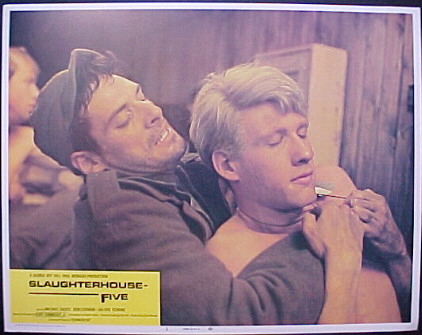
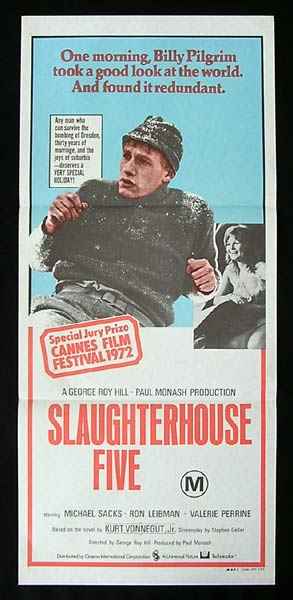
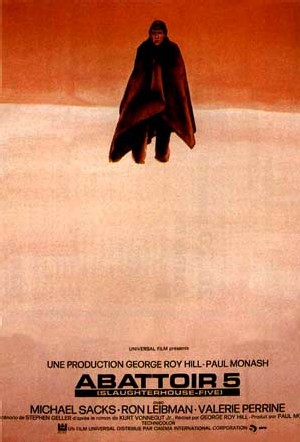
Slaughterhouse-Five (1972)

Nora's Nite
Pasta with SuperDelicious Meat Sauce with mushrooms, onions and tomatoes, Cookies, Ice Cream
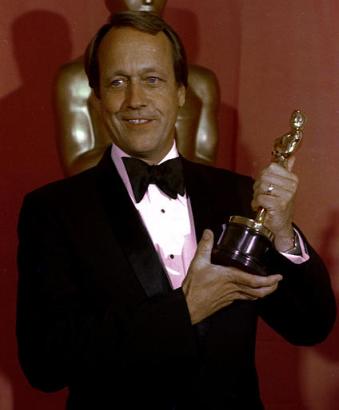
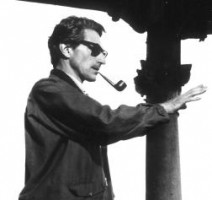
Jonathan Kiefer on George Roy Hill: There's a great story about how George Roy Hill used to spook fatuous Hollywood studio executives by buzzing their office tower with his antique open-cockpit biplane. He would come in low, blending with the skyline at first, then, with a crescendo of engine roar and a beeline swoop, plunge straight at the conference-room windows, turning sharply up and away just in the nick of time -- or, to really push the envelope, just a split second after the nick of time. The executives might not necessarily accede to Hill's creative demands from then on, but they would possibly wet themselves.

The story implies a spirited, bravely black-humored, possibly dangerous, but ultimately appealing lone adventurer (read: a George Roy Hill protagonist). It was told by Stephen Geller, who wrote the screen adaptation of Kurt Vonnegut's Slaughterhouse Five for Hill to direct, and it sounds like a tall tale -- Geller is a peerless raconteur -- until you consider the recorded manifestations of Hill's personality.

Take, for instance, what is widely viewed as Hill's most cherished film project, The Great Waldo Pepper (1975), with Robert Redford as a flying stuntman who tends to articulate his more dramatic sentiments aerially. Or the great, ridiculous scene in Hill's movie of John Irving's The World According to Garp (1982), in which a sputtering small plane emerges from the nether-regions of suburbia to crash into the protagonist's first house just as he's about to buy it. "We'll take the house," Garp cheerfully replies. "It's been pre-disastered!"

Perhaps it goes without saying that this scene is not in the book, but it should be mentioned that the pilot in the movie is Hill himself, who, after wrecking the house, politely asks if everyone is all right and then asks to use the telephone. The moment seems to expose the director's creative attitude toward life in this world, and it's a relief to say that even after September 11, it's still very moving and funny.

George Roy Hill died recently, just after his 81st birthday, from complications of Parkinson's disease. Low-flier that he was, his passing evaded a few radar screens, but his contribution is worth remembering.

Born in Minneapolis, Hill studied music at Yale, then served as a Marine transport pilot in the South Pacific during World War II. The G.I. Bill allowed him to further his studies of music and literature at Trinity College in Dublin, where he began acting, with Cyril Cusack's company at the Abbey Theatre. There, Hill promptly made a successful move into directing, and then brought that success to Broadway. After more military service during the Korean War, he began writing, producing, and directing for American television during its mid-fifties golden age. His first theatrical feature film was an adaptation of Tennessee Williams' Period of Adjustment, which Hill had directed on Broadway.

Hill didn't start making films until the age of 40, and he stopped at 66, with 14 singular, award-winning, and influential works to his credit. He is most famous for originating the screen team of Paul Newman and Robert Redford, without which, it is safe to say, American cinema would be significantly blander. The team only convened for two films, Butch Cassidy and the Sundance Kid (1969) and The Sting (1973), but their mark on future generations of on-screen con men, lovable bandits, and other basically good bad guys is indelible. (There is also the matter of Redford's moviemaking sub-empire, gratefully named for the role that made him a star.)

Some of his flights of fancy, perhaps predictably, crashed and burned. But the majority of Hill's films are smartly entertaining and richly quirky. For a while, he was the only director in history to have made two of the top 10 moneymakers (the Redford-Newman films), a real feat for someone who, rather unlike the cookie-cutter moviemakers enjoying similar -- and useless -- accolades now, did such truly personal work and still made it popular. Bear in mind that Hill, during his television days, was responsible for A Night to Remember, the original Titanic movie, and the first version of Judgment at Nuremberg, the original Holocaust confrontation movie.

What the cinema will really miss, though, is his charisma, his voice. What Roger Ebert wrote of Funny Farm, the last, is true of many George Roy Hill pictures: the director "enlists our sympathies with the characters even while cheerfully exploiting their faults." Hill did make his characters suffer -- dramatically and comically. It wasn't schadenfreude, but rather something close to the opposite, a tough and tender kind of empathy, and the resolve to laugh, hard, at affliction.

For all the delight he took in vindicating the heady schemers of The Sting, Hill seemed to feel most deeply for the humiliations suffered by Garp, or the passive, put-upon Billy Pilgrim of Vonnegut's novel. Butch and Sundance were ultimately doomed, themselves "pre-disastered," but that fact never impeded their symbiotic sense of humor.

William Goldman, who wrote Butch Cassidy and the Sundance Kid and won an Oscar for it, finds the movie especially vindicating, and Vonnegut and Geller are both rightly proud of Slaughterhouse Five. That too is a major feat for any film director who dares adapt any book. John Irving was less pleased, but one look at his sodden The Cider House Rules suggests he should count his blessings.

Because you must go somewhere after the funny farm, Hill returned to teach at Yale. He didn't talk to the press much (he never had), so he was periodically characterized as a "recluse." A lone adventurer, perhaps, but not a recluse. At least his colleagues didn't seem to see him that way. But perhaps they were ducking under their desks.
TIME on Slaughterhouse-Five: Vonnegut is still more cult favorite than literary lion (and he probably prefers it that way), but he deserves full canonical marks for this kaleidoscopic koan of a novel about Billy Pilgrim, a man who has "become unstuck in time." Pilgrim ricochets helplessly from decade to decade, living the episodes of his life in no particular sequence, not excluding his own death, his capture by aliens called Tralfamadorians, and his traumatic service in World War II, when he lives through the firebombing of Dresden. Slaughterhouse-Five is a cynical novel, but beneath the bitter, grim-jawed humor is a desperate, painfully honest attempt to confront the monstrous crimes of the 20th century.
NY Times Reviews Slaughterhouse-Five via Vonnegutweb: Kurt Vonnegut Jr., an indescribable writer whose seven previous books are like nothing else on earth, was accorded the dubious pleasure of witnessing a 20th-century apocalypse. During World War II, at the age of 23, he was captured by the Germans and imprisoned beneath the city of Dresden, ''the Florence of the Elbe.'' He was there on Feb. 13, 1945, when the Allies firebombed Dresden in a massive air attack that killed 130,000 people and destroyed a landmark of no military significance.

Next to being born, getting married and having children, it is probably the most important thing that ever happened to him. And, as he writes in the introduction to Slaughterhouse-Five, he's been trying to write a book about Dresden ever since. Now, at last, he's finished the ''famous Dresden book.''

In the same introduction, which should be read aloud to children, cadets and basic trainees, Mr. Vonnegut pronounces his book a failure ''because there is nothing intelligent to say about a massacre.'' He's wrong and he knows it.

Kurt Vonnegut knows all the tricks of the writing game. So he has not even tried to describe the bombing. Instead he has written around it in a highly imaginative, often funny, nearly psychedelic story. The story is sandwiched between an autobiographical introduction and epilogue.
Via Vonnegutweb.com: Writing in Critique, Wayne D. McGinnis comments that in Slaughterhouse Five, Vonnegut 'avoids framing his story in linear narration, choosing a circular structure.

Such a view of the art of the novel has much to do with the protagonist . . . Billy Pilgrim, an optometrist who provides corrective lenses for Earthlings. For Pilgrim, who learns of a new view of life as he becomes ''unstuck in time,'' the lenses are corrective metaphorically as well as physically. Quite early in the exploration of Billy's life the reader learns that ''frames are where the money is.'' . . . Historical events like the bombing of Dresden are usually 'read' in the framework of moral and historical interpretation.' McGinnis feels that the novel's cyclical nature is inextricably bound up with the themes of 'time, death, and renewal,' and goes on to say that 'the most important function of "so it goes" [a phrase that recurs at each death in the book] . . . , is its imparting a cyclical quality to the novel, both in form and content. Paradoxically, the expression of fatalism serves as a source of renewal, a situation typical of Vonnegut's works,for it enables the novel to go on despite -- even because of -- the proliferation of deaths.'''
Superficial Valarie Perrine bio: This brash, statuesque former Las Vegas showgirl brought a blowzy sultriness and a sweet vulnerability to a number of starring and supporting roles in the 1970s and 80s.

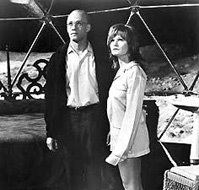
The daughter of a US Army officer and a former Broadway dancer, Valerie Perrine was raised in various places around the world, including Japan. After briefly studying psychology, she began her show business career as a topless dancer in Las Vegas. Perrine traveled throughout Europe and lived for a time in Paris before finally settling in L.A. in the early 70s. Landing her first role as Montana Wildhack in George Roy Hill's screen adaptation of Kurt Vonnegut Jr.'s "Slaughterhouse-Five" (1972), she was singled out for her portrayal of a voluptuous kidnapped bride of the hero (Michael Sacks).

This led to her first starring role as the trampy girlfriend of race car driver Jeff Bridges in "The Last American Hero/Hard Driver" (1973). Perrine had what was perhaps her best role to date as Honey Harlowe, the drug-addicted stripper-wife of comic Lenny Bruce in Bob Fosse's biopic "Lenny" (1974). Bringing class and smarts to what could have been a stereotypical role, she proved to critics and audiences just how strong an actor she could be, given the right material. Perrine earned awards from critics groups, won an Oscar nomination as Best Actress and received the Best Actress trophy at the 1975 Cannes Film Festival.

Screenwriter Stephen Geller is now Associate Professor of Film at BU:

BA, Dartmouth College; MFA, Yale University. Professor Geller has taught film and the creative process at Dartmouth College, in the MFA Creative Writing Program at Arizona State University, and has lectured on cinema throughout the world. An internationally recognized screenwriter, Professor Geller has worked for nearly 30 years in the American, French, Italian, and British film industries. His screenplay for Slaughterhouse-Five won the Special Jury Prize at the Cannes Film Festival, as well as a nomination by the Writer's Guild of America. His miniseries, Warburg: A Man of Influence, won the coveted European Silver Award for Best Miniseries. Most recently, with his writer-wife Kae, he wrote and performed in the play Opportunities in Zero Gravity in Boston and New York and, also with his wife, won the Zoetrope International Internet Film Festival for their short film, Cuppa Cabby, Piece O' Pie, which played in national and international film festivals. He has published four novels, a book on screenwriting, and has written extensively for diverse publications.

Geller recently made his own low budget film:
Geller first had to raise money and recruit a cast and crew, then survive on four hours' sleep a night as he juggled filmmaking with summer classes, a wife and five-year-old daughter, and a cast that included nearly a dozen young, partying actors. Why not just write the script and shop it around Hollywood? Because, he answers, he has been disappointed too many times to let others interpret his work. “I've been paid to write forty-two films,” he says, “and nine have been made, and I have never been satisfied with the direction of a majority of them, except for George Roy Hill's direction of Slaughterhouse-Five. The rest of the time I found that I was brighter than most directors, actually knew more about film, and cared more about film. And so this time, I knew I was going to make this movie.”

The film was shot in twenty-nine days, cost $125,000, and “everybody who was involved owns a piece of it,” Geller says. Almost all the cast and crew were BU faculty and students, which helped make the balancing act work. Geller's wife, Kae, a film lecturer at COM, played a major role, and their daughter, Florrie, was junior production assistant. “He'd written one of the most extraordinary parts ever written for a woman,” says Kae, who has cowritten and starred in several projects. “It was an amazing experience to be a part of it.” Colleague Kevin Bliss (COM'96), also a COM film lecturer, took a role in the film even before reading a final draft of the script. “I know Steve,” he says, “and I knew I'd feel good about whatever he writes.”

Geller's more than thirty years in the film industry have earned him a reputation primarily for screenwriting. Among his credits are the adaptation of Kurt Vonnegut, Jr.'s Slaugherhouse-Five, for which he won a Special Jury Award at the Cannes Film Festival and a Writers Guild nomination for Best Screen Adaptation, and Warburg: A Man of Influence, a miniseries that won the European Silver Medal Award for Best Miniseries of 1992.

“I had had nine contracts to direct something I had written,” he says, “but for a variety of reasons they never came through. Either I walked away because it didn't contain the elements I wanted, or the producer found me unbearable, or we lost the money.”

Why might a producer find him unbearable? “Because I know what I want,” Geller says. “And my experience with producers and directors is that they don't know what they want.” He likens shooting a movie to “watching water boil. I love the writing, I love the rehearsals, I love the cutting. The shooting itself is an absolute bore.”
Bombing of Dresden:Contemporary official German records give a number of 21,271 registered burials, including 6,865 who were cremated on the Altmarkt.[26] There were around 25,000 officially buried dead by March 22, 1945, war related or not, according to official German report Tagesbefehl (Order of the Day) no. 47 ("TB47"). There was no registration of burials between May and September 1945.[27] War-related dead found in later years, from October 1945 to September 1957, are given as 1,557; from May 1945 until 1966, 1,858 bodies were recovered. None were found during the period 1990-1994, even though there was a lot of construction and excavation during that period. The number of people registered with the authorities as missing was 35,000; around 10,000 of those were later found to be alive.[28] In recent years, the estimates have become a little higher in Germany and lower in Britain; earlier it was the opposite.

Overall, Anglo-American bombing of German cities claimed around 400,000 civilian lives. Whether these attacks hastened the end of the war is a controversial question. As acts of retaliation, they were at best vicarious (even if entire nations are seen as morally competent agents).

Sunday, January 08, 2006

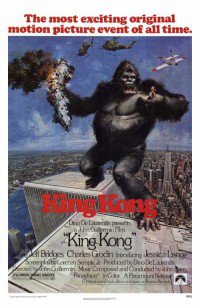
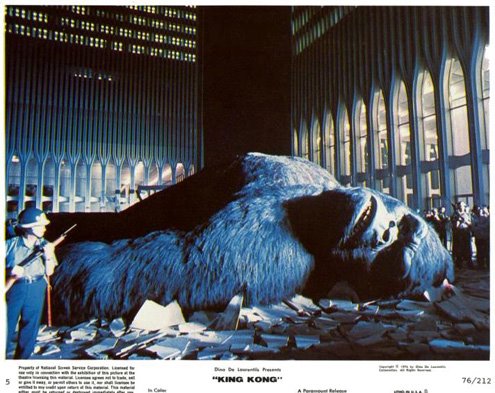
King Kong (1976)

First Movienite in Pamela's new house!


Pamela's Nite
Pork Roast, Cous-cous, Cabbage, Lemon Totes a la Bruckheimer
Time Magazine on 1976 King Kong:

For the past two months, ads have been splashed throughout the press proclaiming that King Kong will love and die again—not once but twice. In early January both Universal and Paramount will start production on $12 million remakes of the 1933 classic. Universal believes that the film will gross somewhere between Jaws and Earthquake. Paramount's director Dino de Laurentiis declaims boldly that King Kong 'is still the most exciting original motion picture event of all time.'
From Monkey Business
Jan. 5, 1976

In the $13 million movie's seventh week of production, King Kong still lacks a star. In his race to beat rival Universal's King Kong project, De Laurentiis won a court battle but apparently neglected to get the ape off the drawing board. All of the 40-ft. mechanical Kong he has so far is a pair of mighty arms that cost $450,000 and have developed on-camera arteriosclerosis. The producer has rushed over so many Italian technicians to get the monkey off his back that pasta is outselling pastrami at the studio commissary.
From King Klunk
Apr. 5, 1976

After a troublesome nine-month gestation, King Kong is alive and well and going through toilet training in Hollywood. The 40-ft. star of Dino De Laurentiis' $22 million ape epic made his public debut at MGM's back lot and, considering that his innards are almost as complex as those of a Polaris missile, the king showed surprisingly few kinks. (The ape whose death was staged last June at Manhattan's World Trade Center for the film's final scene was a Styrofoam stand-in.)
From The King Leaks
Aug. 30, 1976

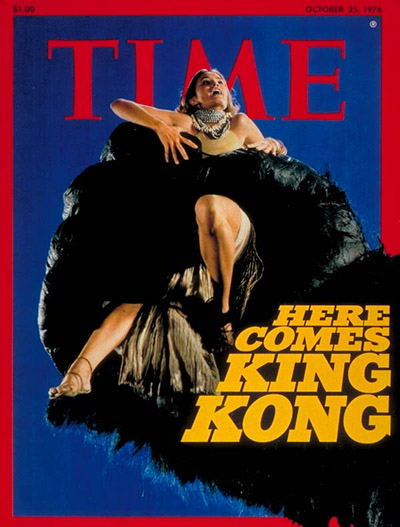
Like the first King Kong, produced 43 years ago, the new version plunges one quickly into the heart of that special critical darkness indigenous to the movies. On the face of it, nothing could be more preposterous than this story of the love affair between the oddest couple in popular culture: a blonde whose beauty is matched only by her dimness of mind (at least in the original) and an ape who is 40 ft. tall, fierce of mien and manner, yet at heart just a big adolescent, bumbling spectacularly through the throes of his first—often literally crushing—crush.
From Here Comes King Kong
Oct. 25, 1976

There was something darkly enigmatic about the original Kong. Fay Wray had stirred the softer side of his nature and forced him, as it were, to re-examine some of his premises. But no matter how tenderly he picked her up, one never knew whether he would lose control of his enormous strength and destroy what he seemed to love. The very blankness of his expression reinforced the anxiety. When the old Kong breaks loose in New York, he is angry—no question about it. He will have his vengeance on his captors and on those who come to gawk at his pain. The new Kong does accidentally mangle a few people, but there's no real rage in him.
From The Greening of Old Kong
By Richard Schickel
Dec. 27, 1976
Review of 2005 version:
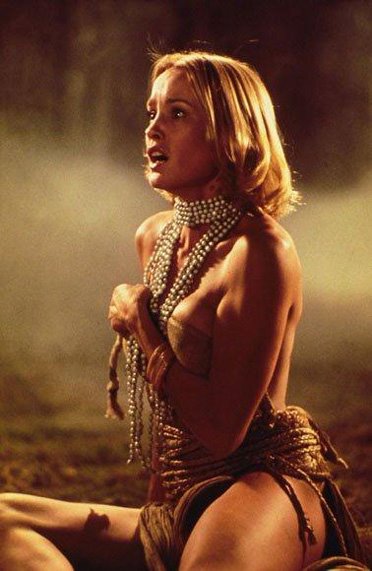
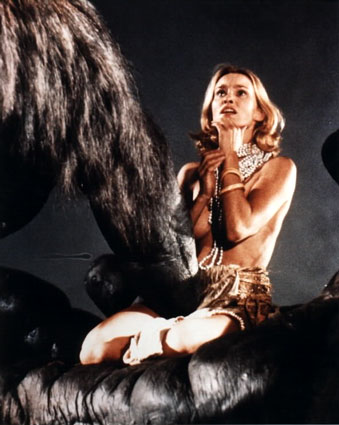
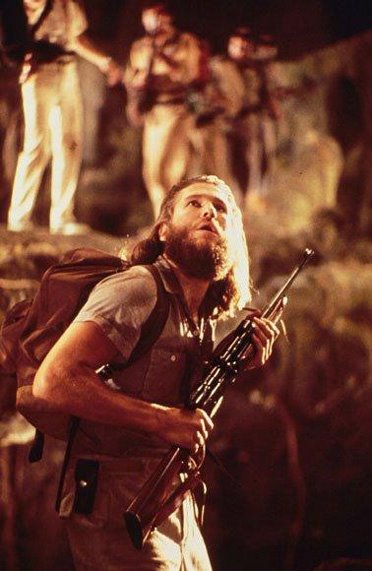
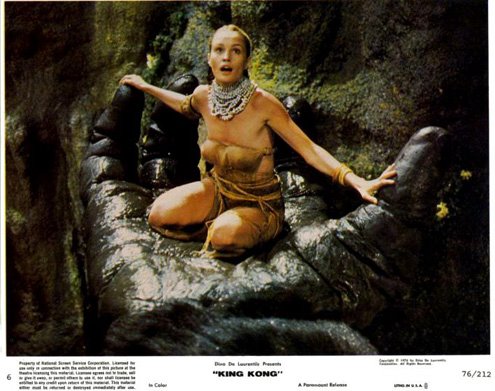
In 1976, Lorenzo Semple Jr.'s most important innovation was to have the female lead (called Dwan, played by Jessica Lange) reciprocate the Beast's feelings. Kong was fascinated by Dwan. After an initial bout of fear and anger, she accepted him as a gentle protector. Atop the World Trade Center, she risked her life to save his, and her world came apart when he fell. The male lead (Jeff Bridges) was also shown as being sympathetic to Kong.

For the 2005 version, Jackson has followed the 1976 movie's lead, and developed a tender, two-way relationship between Ann and Kong. This is meticulously advanced over the course of the movie - particularly in three scenes. The first has Ann doing a song-and-dance routine that amuses Kong and convinces him not to kill her. The second has Ann moving behind Kong during a battle, acknowledging him as her "champion." And the third involves a frozen pond in Central Park, and may represent King Kong's most magical moment, and Jackson's lasting contribution to the legend. Unlike in the 1976 movie, Jack is not kindly disposed toward Kong. This may be why, in the end, the bond between Ann and Kong seems stronger than the one between Ann and Jack. And the reunion of the two human lovers after Kong's plunge rings hollow. We don't really care about Ann and Jack. The character we do care about has just died. His final moments with Ann are quietly heartbreaking.
New York Times Guillermin bio:
British filmmaker John Guillermin was all of 22 when he was mustered out of the RAF and began making documentaries in France. Hoping to hone his cinematic technique, Guillermin studied the Hollywood studio system first-hand in the latter part of the '40s, then made his feature-film debut at 24 with the British melodrama Torment. More prodigy than genius, Guillermin stuck to safe commercial fare along the lines of Miss Robin Hood (1952) and Operation Diplomat (1953) throughout the '50s. His budgets and box-office pull improved with such films as I Was Monty's Double (1957), The Day They Robbed the Bank of England (1960), Tarzan Goes to India (1962) and The Blue Max (1966), films that did as well in the U.S. as they did in England. On the strength of these projects, Guillermin returned to Hollywood, where he helmed the 1968 George Peppard detective picture P.J., then directed another "early bloomer," Orson Welles, in House of Cards (1969). After the high point of The Towering Inferno (1974), Guillermin's work became less distinctive; on such later films as King Kong (1976) and Death on the Nile (1978), he was just another technician, whose direction was no better or worse than his scripts. John Guillermin's most recent film was King Kong Lives (1986).
Dino De Laurentiis bio: A colorful and flamboyant producer, Dino De Laurentiis has produced a remarkable range of motion pictures ranging from art-house fare (e.g., Fellini's "La Strada" 1954), camp classics ("Barbarella" 1968), overblown spectacles ("Tai Pan" 1986) and popular entertainments ("Hannibal" 2001). In all, he has either financed, produced or distributed over 600 movies and with the dawn of the new millennium and his seventh decade in the industry, he has shown no inclination of stopping.

Born near Naples, Italy, De Laurentiis entered his father's pasta business while still a teenager, but the idea of selling spaghetti did not appeal to the young man. Moving to Rome, he enrolled in the Centro Sperimentale di Cinematografia and supported himself with acting roles and behind the scenes work until he decided to become a producer. In 1939, he debuted as the producer of "Troppo tardi t'ho conosciuta" but it was another nine years before he enjoyed a real international success with the neo-realistic "Riso Amaro/Bitter Rice" (1948). The film starred a buxom Sylvana Mangano whom De Laurentiis married in July 1949 and would star in "Il Lupo della Sila/The Lure of Sila" (1949), "Il Brigante Musolino/Outlaw Girl" (1950) and "Anna" (1951), all of which he produced.

In the 50s, De Laurentiis joined with Carlo Ponti in forming a production company that oversaw several prestigious Italian films, including Fellini's Oscar-winning "La Strada", "Attila" and "The Miller's Wife" (both 1955) and "Guendalina" (1957) before dissolving their partnership. By that time, he had branched out on his own, overseeing the epic "War and Peace" (1956), directed by King Vidor and starring Audrey Hepburn and Henry Fonda, and a reteaming with Fellini on the Oscar-winning "The Nights of Cabiria" (1957). In 1959, De Laurentiis oversaw his third Academy Award nominated foreign-language motion picture, "The Great War".

As the 60s unfolded, De Laurentiis built his own studio, Dino Citta, and alternated teaming with some of the European cinema's finest filmmakers like Vittorio De Sica ("The Last Judgment" 1962), Jean-Luc Godard ("Pierre le fou" 1965) and Claude Chabrol ("An Orchid for the Tiger" 1965) with more "popular" films like the religious-themed dramas "Barrabas" (1962) and the John Huston-directed "The Bible" (1966). This combination of art-house and commercial fare perhaps reached its most absurd in 1968 with the odd combination of Francois Truffaut's "The Bride Wore Black" and Roger Vadim's "Barbarella".

When Dino Citta failed, De Laurentiis relocated to the USA in the 70s and initiated a run of films that proved popular at the box office. He was producer of "The Valachi Papers" (1972), which was based on fact and purported to tell the "real" story that a film like "The Godfather" couldn't. "Serpico" (1973) garnered praise for its true-life tale of police corruption and for Al Pacino's magnificent portrayal of the title role. "Death Wish" (1974) perhaps tapped most into the zeitgeist, serving up a revenge tale that spawned several sequels and countless imitations. The spy thriller "Three Days of the Condor" (1975) combined the elements of pulp entertainment with highbrow aspirations, embodied in star Robert Redford and director Sydney Pollack. But De Laurentiis could also stoop low, as the dreadful "Mandingo" (1975) and its even more noisome sequel "Drum" (1976) can attest. Yet, perhaps the producer's biggest act of hubris was undertaking the remake of the 1933 classic "King Kong" (1976), which divided critics and audiences. Not losing his flair for the high-brow, De Laurentiis reteamed with Fellini one last time for "Fellini's Casanova" (1976), the director's ill-fated biopic of the great lover. He also produced Ingmar Bergman's venture into English-language filmmaking "The Serpent's Egg" (1978). Of this period, perhaps "Ragtime" (1981), the Milos Forman-helmed adaptation of E L Doctorow's historical novel, was the most intriguing.

In 1983, amid much fanfare he announced the formation of the De Laurentiis Entertainment Group (DEG) which included a state-of-the-art film studio in Wilmington, North Carolina. Serving as chair and CEO, De Laurentiis oversaw an ambitious slate of films, most of which proved to be box-office disappointments. Despite the presence of stars Anthony Hopkins and Mel Gibson, "The Bounty" (1984), a retelling of the famous mutiny, did not find an audience. "Dune" (1984), David Lynch's overly ambitious, unsuccessful distillation of Frank Herbert's classic sci-fi novel, proved an expensive failure as did such other pedigreed projects like "Year of the Dragon" (1985) and "Tai Pan". In 1988, De Laurentiis ceded defeat and resigned from DEG. Perhaps a lesser figure would have been driven from the industry, but not this formidable producer.

Rebounding, De Laurentiis made his first foray into American television with the CBS adaptation of "Stephen King's 'Sometime They Come Back'" (1991). He signed Madonna to star in "Body of Evidence" (1993), a "Basic Instinct"-inspired knockoff. For Showtime in 1995, De Laurentiis returned to the biblically-inspired films of the 60s and oversaw a remake of "Solomon and Sheba" as well as the tale of Joseph and his relationship with Potiphar's wife (misleadingly titled "Slave of Dreams"). Although "Unforgettable" (1996) wasn't, he enjoyed a critical hit with "Breakdown" (1997) and then reteamed with that film's writer-director Jonathan Mostow for the WWII-era tale "U-571" (2000).

De Laurentiis' production company had long held the rights to Thomas Harris' novels and was behind the Michael Mann-helmed "Manhunter" (1986), but when it came time to film "The Silence of the Lambs" in 1990, the company passed, only to see the film become a phenomenon and multiple Oscar winner. Despite the critical drubbing the original novel took and the defection of star Jodie Foster and director Jonathan Demme, De Laurentiis was determined to bring the long-awaited sequel "Hannibal" to the screen. Securing Anthony Hopkins to reprised his now signature role of Dr Lector, and rounding out the creative team with Julianne Moore (as FBI agent Clarice Starling) and Ridley Scott in the director's chair, the high profile project opened in theaters in 2001, just before its producer received the Irving G Thalberg Award from the Academy of Motion Picture Arts and Sciences.
Lorenzo Semple Jr. credits:

Sheena (1984)
Johnny Dangerously (1984)
Never Say Never Again (1983)
Flash Gordon (1980)
Hurricane (1979)
King Kong (1976)
Three Days of the Condor (1975)
The Drowning Pool (1975)
The Parallax View (1974)
Papillon (1973)
Daddy's Gone A-hunting (1969)
Fathom (1967)
Rick Baker, "Man in an Ape Suit":
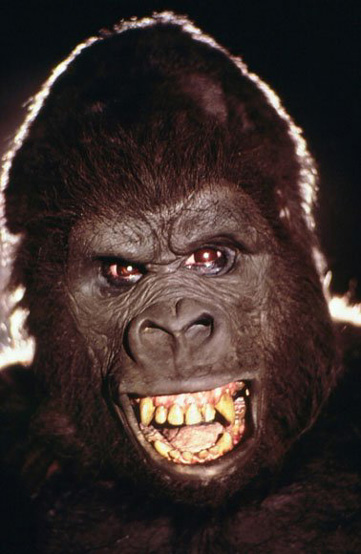
After reading the script, Rambaldi determined that they would need seven masks, each one animatronically controlled to provide a range of expressions. More than one mask was necessary because there wasn't room in a single mask to include all the cables and mechanics required for all the expressions. Rick Baker, though hired to wear the costume, was also called upon to sculpt the mold used to make the outer latex skins of the masks.

The masks were built up much like a real face, starting with a plastic "skull" over which were placed artificial muscle groups activated by cables which entered the costume through Kong's feet. Though the full-size Kong used hydraulics to provide movement, there wasn't room in the masks for the tubes which a hydraulic system would require. Hence the use of cables controlled by operators working at control boards just off the set.

As revolutionary as the animatronic masks were, the rest of the costume was itself a feat of engineering which set the standard for later costumes, and served as the suitprecursor for everythingsuit from Batman's muscled-up Batsuit to Hellboy's "ripped" scarlet torso. (You didn't really think Ron Perlman looked like that, did you?)

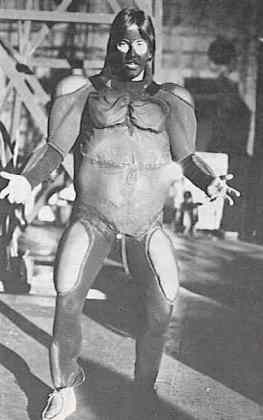
Far from being a simple zippered boo-suit, the costume invented for Kong '76 (actually four costumes were used) realistically depicted the appropriate musculature beneath the fur through a special undersuit with silicone filled muscles.

The costume's hands used animatronic extensions, again controlled by operators off set, so as to give Kong appropriately gorilla like long limbs. It was pointed out that the only parts of Rick Baker actually visible on film were his eyes -- and even those were gorilla-fied using contact lenses! (Rick Baker explained that the key to a good gorilla suit is in the eyes. If they look too human, the entire effect is lost.)

So complex was the result of all this technology that to use the word "costume" seems wholly inadequate. It was more nearly a state-of-the-art, remotely-controlled, mechanized "exo-skeleton".

Sadly, Rick Baker had few good memories of his work on Kong '76, feeling under appreciated, that his suggestions were too readily ignored (he wanted Kong to knuckle-walk) and that his contributions were unfairly downplayed -- which of course they were. The credits merely read: "With special contributions from Rick Baker."

Nonetheless, he had little reason to worry as, in spite of the misleading press, it was well known that he had played Kong in the "ape suit", and he received only praise, even from those who pilloried the film itself. And it seems likely that Baker owes his present status as a top Hollywood make-up man to the initial boost given him from the publicity surrounding King Kong 1976.

But who'd have thought a guy could make a life-time profession out of dressing up like gorillas?!

Sunday, December 18, 2005

Metropolis (1927)


Stuart's Nite
CPK Pizzas, Cookies
Special Guest: Lisa Ottotique
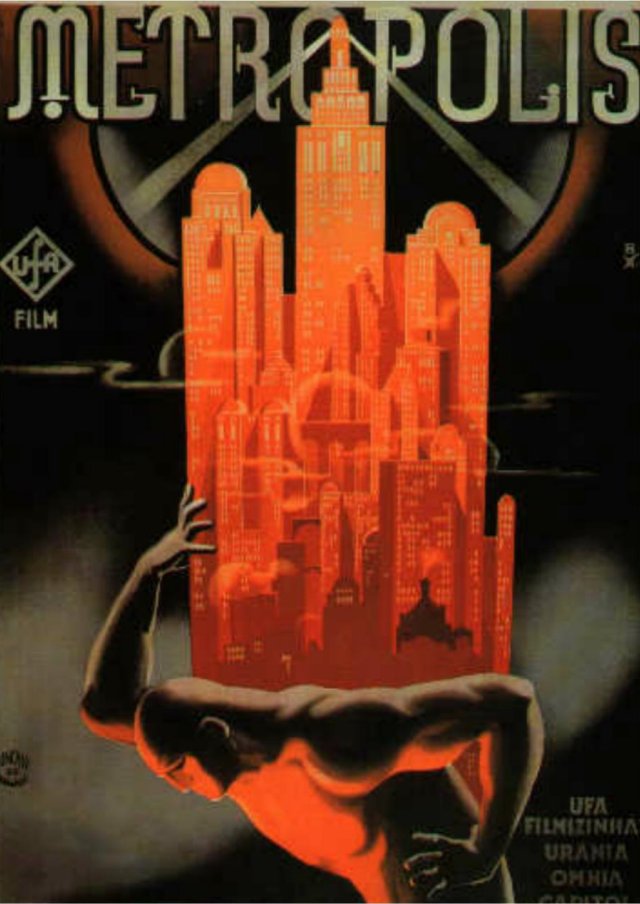
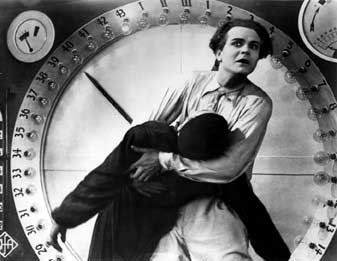
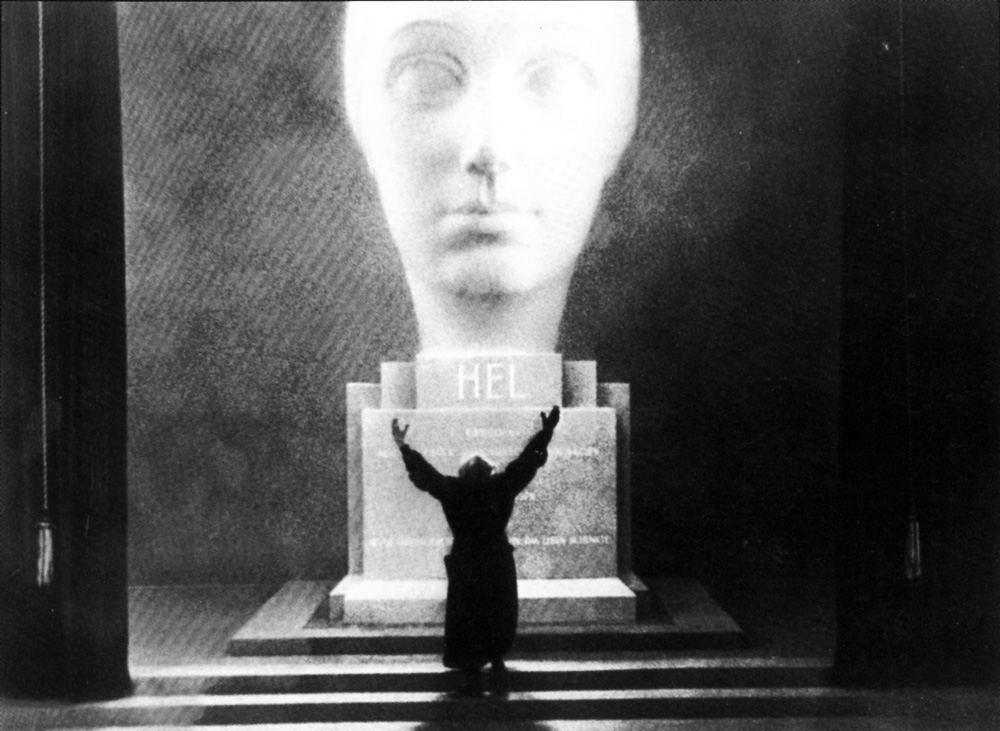
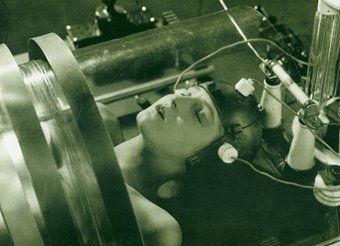
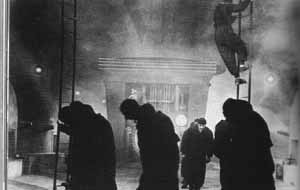
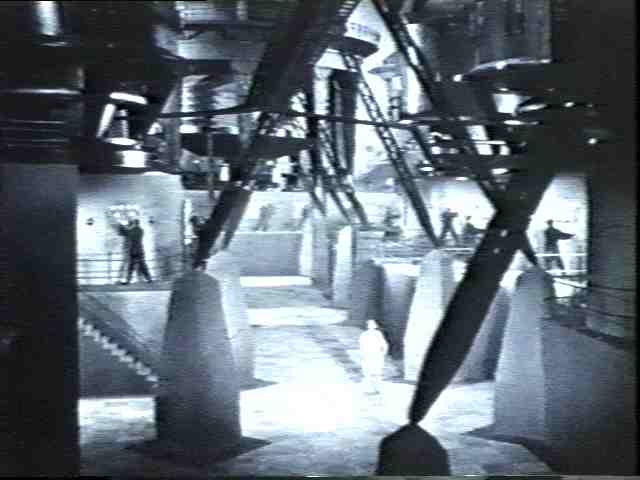
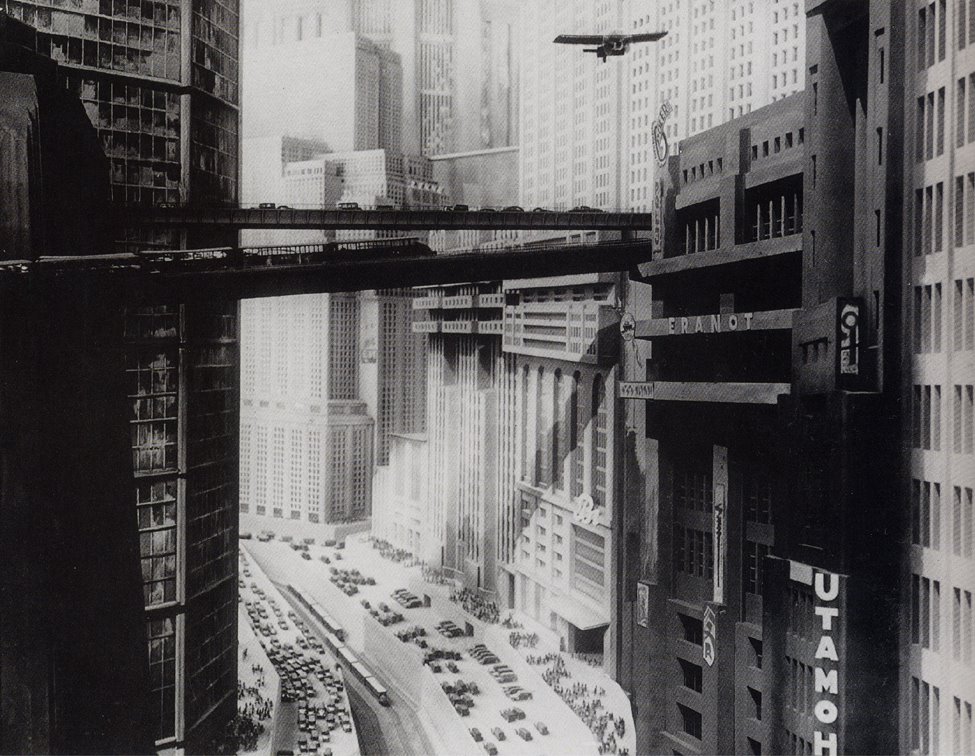
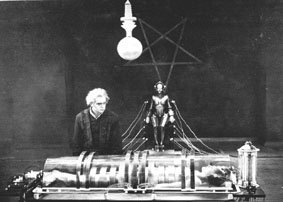
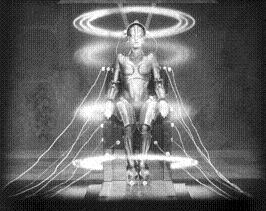
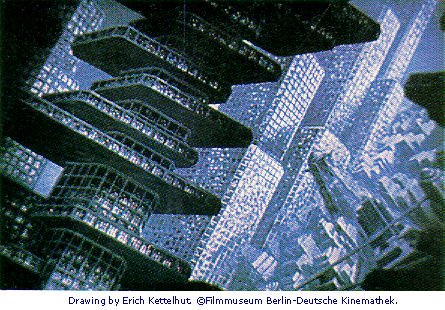
Film Forum: Inspired (or so legend says) by his first glimpse of the Manhattan skyline, Fritz Lang's visionary work of science fiction redefined the term "super-production" - in the process nearly bankrupting Ufa studios - with its thousands of extras (cheap, in the era of Weimar hyperinflation); already-monstrous sets inflated to the gargantuan by cutting-edge camera trickery (including the first use of the legendary Schüfftan process, whereby miniatures and live action are filmed simultaneously); and eye-popping special effects extravaganzas, including the explosion of the "heart machine;" the Frankenstein-like genesis of the robot girl; and a cataclysmic, multitude-engulfing flood.

A legend and a byword almost from first release, Metropolis was seen as Lang conceived it only by the earliest Berlin audiences ("positively overwhelming" raved the Variety critic after the premiere) - and then the cutting began, by the U.S. distributor Paramount, by Ufa itself, and so on, down to a 1984 "restoration" that ran only 87 minutes.

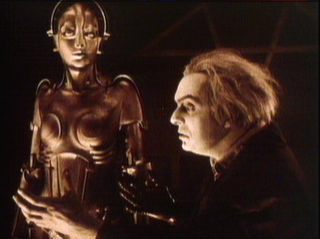
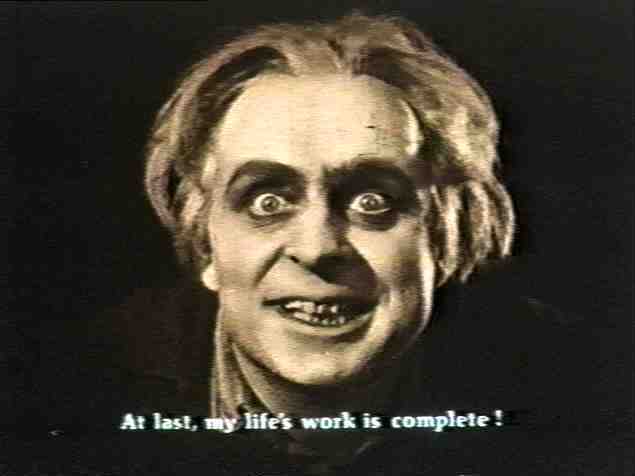
Roger Ebert: Generally considered the first great science-fiction film, ``Metropolis'' (1926) fixed for the rest of the century the image of a futuristic city as a hell of scientific progress and human despair. From this film, in various ways, descended not only ``Dark City'' but ``Blade Runner,'' ``The Fifth Element,'' ``Alphaville,'' ``Escape From L.A.,'' ``Gattaca,'' and Batman's Gotham City. The laboratory of its evil genius, Rotwang, created the visual look of mad scientists for decades to come, especially after it was mirrored in ``Bride of Frankenstein'' (1935). And the device of the ``false Maria,'' the robot who looks like a human being, inspired the ``Replicants'' of ``Blade Runner.'' Even Rotwang's artificial hand was given homage in ``Dr. Strangelove.''

What many of these movies have in common is a loner hero who discovers the inner workings of the future society, penetrating the system that would control the population. Even Batman's villains are the descendants of Rotwang, giggling as they pull the levels that will enforce their will. The buried message is powerful: Science and industry will become the weapons of demagogues.

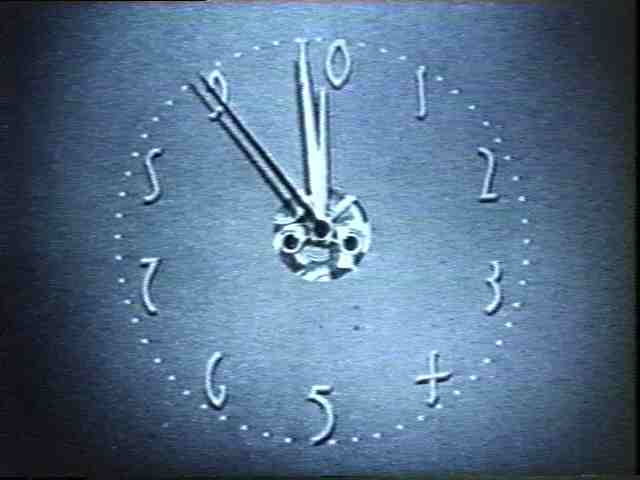
``Metropolis'' employed vast sets, 25,000 extras and astonishing special effects to create two worlds: the great city of Metropolis, with its stadiums, skyscrapers and expressways in the sky, and the subterranean workers' city, where the clock face shows 10 hours to cram another day into the workweek. Lang's film is the summit of German Expressionism, the combination of stylized sets, dramatic camera angles, bold shadows and frankly artificial theatrics.

The production itself made even Stanley Kubrick's mania for control look benign. According to Patrick McGilligan's book Fritz Lang: The Nature of the Beast, the extras were hurled into violent mob scenes, made to stand for hours in cold water and handled more like props than human beings. The heroine was made to jump from high places, and when she was burned at a stake, Lang used real flames. The irony was that Lang's directorial style was not unlike the approach of the villain in his film.

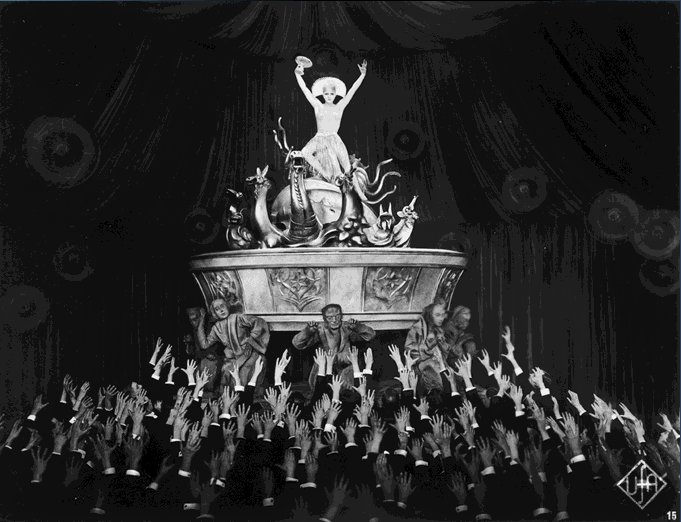
Other dramatic visual sequences: a chase scene in the darkened catacombs, with the real Maria pursued by Rotwang (the beam of his light is like a club to bludgeon her). The image of the Tower of Babel as Maria addresses the workers. Their faces, arrayed in darkness from the top to the bottom of the screen. The doors in Rotwang's house, opening and closing on their own. The lascivious dance of the false Maria, as the workers look on, the screen filled with large, wet, staring eyeballs. The flood of the lower city and the undulating arms of the children flocking to Maria to be saved.

Much of what we see in ``Metropolis'' doesn't exist except in visual trickery. The special effects were the work of Eugene Schuefftan, who later worked in Hollywood as the cinematographer of ``Lilith'' and ``The Hustler.'' According to Magill's Survey of Cinema, his photographic system ``allowed people and miniature sets to be combined in a single shot, through the use of mirrors, rather than laboratory work.'' Other effects were created in the camera by cinematographer Karl Freund.

``Metropolis'' does what many great films do, creating a time, place and characters so striking that they become part of our arsenal of images for imagining the world. The ideas of ``Metropolis'' have been so often absorbed into popular culture that its horrific future city is almost a given (when Albert Brooks dared to create an alternative utopian future in 1991 with ``Defending Your Life,'' it seemed wrong, somehow, without Satanic urban hellscapes). Lang filmed for nearly a year, driven by obsession, often cruel to his colleagues, a perfectionist madman, and the result is one of those seminal films without which the others cannot be fully appreciated.
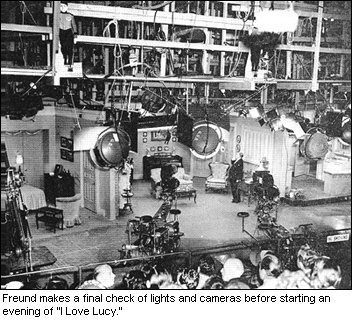
Cinematographer Karl Freund went on to a long Hollywood career, Oscar Bio: Born in Königinhof, Bohemia, Austria-Hungary (now Dvur Kralove, Czech Republic). At the age of 15, Karl Freund began his long, illustrious career in motion pictures as a projectionist. Within two years, he had graduated to camera operator and received a variety of assignments, including newsreels and shorts. In the 1920s, Freund worked at the UFA studios during what has become known as the Golden Age of German cinema. Collaborating with such film artists as Fritz Lang, F.W. Murnau, Paul Wegener and E.A. Dupont, Freund helped to create some of the most beautiful and highly regarded films of the silent era. In 1924, he worked on THE LAST LAUGH with Murnau and screenwriter Carl Mayer. Mayer collaborated closely with Freund to write a script exploiting the potentials of a moving camera. The camera became an integral part of the narrative, interpreting and visualizing the central character's state of mind. To film one scene where the main character is intoxicated, Freund strapped the camera to his chest, batteries to his back for balance, and stumbled about like a drunken man.
In 1925, Freund worked on VARIETY, directed by E.A. Dupont. Once again, Freund's expressive camerawork drew a great deal of praise. Faced with numerous inquiries about the innovative camerawork, Dupont wrote an article for the New York Times explaining the "photographer's ingenuity" in making the film. In 1927, Freund worked with Walter Ruttmann on BERLIN - THE SYMPHONY OF A GREAT CITY. To achieve greater flexibility in difficult shooting situations, Freund developed a special high-speed film stock. The entire documentary was reportedly shot without a single person spotting the camera.

In 1929, Freund came to the United States to work on an experimental color process for Technicolor. Shortly thereafter, he went to work for Universal Studios, shooting DRACULA (1931) and MURDERS IN THE RUE MORGUE (1932). While under contract at Universal, he directed several films, including THE MUMMY (1932). He went on to work at MGM and Warner Brothers, receiving an Academy Award for his cinematography for THE GOOD EARTH (1937). Freund's work in the United States, including such diverse films as KEY LARGO (1948) and PRIDE AND PREJUDICE (1940), reflected his tremendous range and versatility.
Freund on inventing the techinque of the four camera filmed sitcom for I Love Lucy (Does this sound familar, Pamela?):

To film each show we use three BNC Mitchell cameras with T-stop calibrated lenses on dollies. The middle camera usually covers the long shot using 28mm. to 50mm. lenses. The two close-up cameras, 75 to 90 degrees apart from the center camera, are equipped with 3" to 4" lenses, depending on the requirements for coverage.

The only floor lights used are mounted on the bottom of each camera dolly and above each lens. They are controlled by dimmers.

There is a crew of four men to each camera: the cameraman, his assistant, a "grip" and a "cable man." Unlike TV, where one man generally handles the camera movements and views the results immediately, this technique requires absolute coordination between members of the crew.

Every movement of each dolly is marked on the floor for every scene. And since all the movements of the camera are cued from the monitor box, the entire crew works from an intercom system.

As for myself, I utilize a two-circuit intercom. This allows me to talk separately to the monitor booth and the camera crew on one; the electricians handling the dimmers and the switchboard on the other.

Retakes, a standard procedure on the Hollywood scene, are not desirable in making TV films with audience participation. Dubbed-in laughs are artificial and, consequently, used only in emergencies. Close-ups, another routine step in standard film-making, were discarded since such glamour treatment stood out like a sore thumb.

The public acceptance of "I Love Lucy" and "Our Miss Brooks" has been a source of great inspiration for me. The challenge has been a real one -- one I have found both stimulating and exciting.
Danel Griffin: Consider the city itself—an ocean of buildings almost gothic-like in their cathedral shapes, and the airplanes that buzz constantly through the air like small, insignificant bees. Or the underground world of machines that make sure the city runs. This underground workplace is a fortress unto itself, inhabited by faceless, soulless drones who have accepted their fate as the ones who feed the wealthy city above. Some of the first shots that Lang is the back of these men’s heads as they shuffle along to their workplaces, and the image produces goose bumps in its ability to strike us with awe and pity at the same time. Once these images begin, Lang casts a spell on us that is never released, and just when we think that Metropolis has created the ultimate visual achievement, it tops itself with another, and then another (I have two personal favorite images: 1) The clock-like machine in which the protagonist chooses to operate, and 2) the socialist retelling of the story of Babel, with the ocean of bald, moaning heads).
Richard von Busack: Director Fritz Lang makes this an intoxicating mix of dripping romanticism and Biblical fury. It's the cinema's most articulately expressed case of future shock. Metropolis is as pungent as a brilliant editorial cartoon, and it's not dated either. The drones marching into the city's dungeons still chafe the conscience.

Metropolis' repeated motto urges compromise: "Between the mind and the hands, the heart must mediate"--that only common decency can end the war between the haves and the have-nots. This ending was despised by the right and the left alike. Today, it seems insipid--and patronizing too: who decides whether someone's born a "head" or a "hand"?
Fritz Lang Interview:In 1972 my friend, Michael Gould, and I had just graduated from the film program at York University, Toronto, where the school had hosted a number of such luminaries. When we decided to visit Los Angeles together, Michael arranged a number of interviews.

The LA summer was already very hot when we arrived, and Summitridge Drive, high in the Beverly Hills, seemed like a dusty path in some small town on the edge of the Mojave Desert. Fritz Lang's house was small, but it evoked his famous Bauhaus mansion of his UFA days in Weimar, Germany.

Lang welcomed us warmly, smiling and extending both hands, one to each of us, in a gracious gesture full of old-world charm. Surprisingly, considering his reputation on the set, he was a pussycat—soft-spoken, thoughtful and very patient with his two young fans. He served us coffee and delicate cookies from a Viennese pastry shop. Lang had recently undergone a major operation and was recuperating at home. He was tired, but gave freely for several hours, generous with his thoughts and emotions in discussing everything from the art of film to the politics of the '60s.
....
LC: In your work in Germany, you dealt with fantasies and fairytale-like romances, but with M you made an abrupt switch to realism.

FL: Not quite correct. I was born in Austria, yes? I became interested in the German human being. I wanted to make a film about the romantic German human being in Destiny; or the German after the First World War, with the Dr. Mabuse films; or the German of legend with Die Nibelungen; or the German of the future with Metropolis. And then I became a tiny bit tired, which had something to do with my private life, about which I don't want to talk.

Michael Gould (MG): In Metropolis when Maria, the robot, dances for the men in formal attire, there seems to be a series of jump cuts. Were these in the original?

FL: Darling, no. There are no jump cuts. I'll tell you what happened. People cut one film, two films, frames. I don't know. When I was in East Berlin they wanted to reconstruct Metropolis and I couldn't help them because I don't have a script. [Note: the current reconstruction retains these cuts.]

MG: Your German pictures were some of the most expensive films made at the time.

FL: There has been written a lot of lies about Metropolis. There were never thousands of extras. Never.

MG: What was the number?

FL: Two hundred and fifty, 300. It depends how you use a crowd. After the first World War there was an inflation, you know? In Die Nibelungen, I think I had 150 knights. The uniforms would have cost a fortune, but when it came to paying it was no more as if we would have paid one knight at the beginning of the film. It was the first time, I think, in history that a country had such inflation.

MG: Were you anxious to begin making sound films?

FL: No. When I made Woman in the Moon it was my own company, and the release was UFA. One of the higher echelon from UFA was in the United States and had heard sound on the first Jolson film. He came back and asked me to make sound when the rocket starts. And for me, it was wrong. It was breaking the style of the film. So I said no. And UFA said “If you don't do it, we break our contract; we don't pay you anything!” I said ‘Okay, we'll see.' Then my lawyer said to me “Look, Fritz, you have to deliver everything which you promised.” I didn't get paid for eight or nine months, and UFA hoped that I would finally collapse, but I didn't.
....
FL: I admire all film which is good. But you can learn only from a bad film, not from a good film. I prove it: if you are an audience, you go to a good film. Period. If you see a bad film and you say “What is this? That is wrong. I wouldn't have done it that way,” then you have learned something.
Metropolis Film Archive:
There have been many such assessments over the years which praise the film and recognise its landmark status, or are severely critical and dismissive of it as populist kitsch. Such reviews have become more common with the passage of time. However, just as there were glowing reviews, so also scathing criticisms appeared in the press of the day. The most notorious and vitriolic of these was undoubtedly that published in the New York Times on 17 April 1927 by the well-known English science-fiction writer H.G. Wells. He called Metropolis:

...the silliest film. I do not believe it would be possible to make one sillier... That vertical city of the future we know now is, to put it mildly, highly improbable...The hopeless drudge stage of human labour lies behind us. With a sort of malignant stupidity this film contradicts these facts...Then comes the crowning imbecility of the film - the conversion of the likeness of the Robot into Maria...
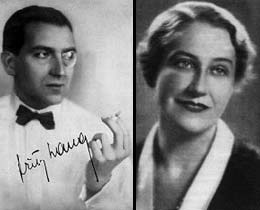
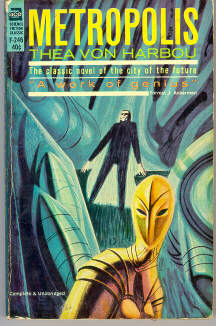
Thea von Harbou (December 27, 1888 – July 1, 1954) was a German actress and author of some noble Prussian descent.

In 1905, she published her first novel in the Deutsche Roman-Zeitung. However, she then started to work as an actress, starting in 1906 in Düsseldorf, then moving to Weimar (1908), Chemnitz (1911) and Aachen (1913). In Aachen she also met her first husband, the actor and director Rudolf Klein-Rogge, whom she married in 1914.

In 1920, she wrote her first movie script Das indische Grabmal (The Indian Tomb, Mysteries of India), together with Fritz Lang. Fritz Lang became her second husband in 1922, and they collaborated a lot in the following years, for instance in writing the screenplay of the famous film Metropolis together. They separated in October 1931 and got divorced in 1933.

In 1932, one year before Adolf Hitler came to power, she joined the NSDAP. This presumably led to the divorce from husband Fritz Lang who left Germany in 1934 for Paris after his latest film Das Testament des Dr. Marbuse had been declared illegal by Nazi officials because of its criticism of Nazi ideology.

Harbou wrote the script for "Der Herrscher" 1937, directed by Veit Harlan and starring Emil Jannings. The movie celebrates unconditional submission under absolute authority, eventually finding reward in total victory.

After the war she was detained by the British military government, and then did some unskilled labor, like cleaning up the rubble from the bombing. After receiving a working permit she did some synchronizing of movies, but also continued to write scripts.

In 1954 She killed herself jumping from a New York City skyscraper.

Sunday, December 04, 2005

Control Room (2004)

Unofficial MovieNite (Stuart sick)
Incredibly late pizza, Ice Cream

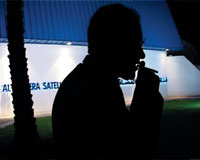
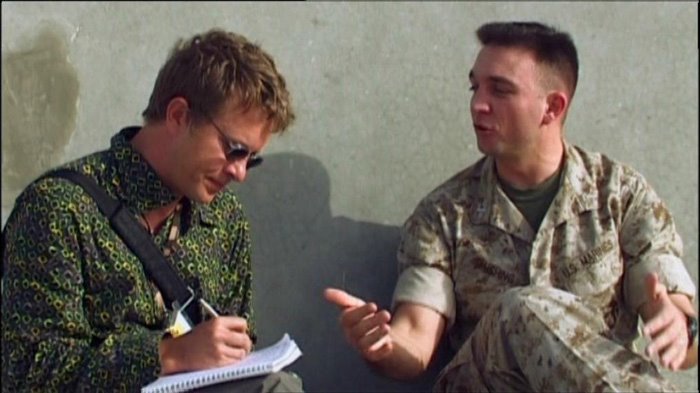
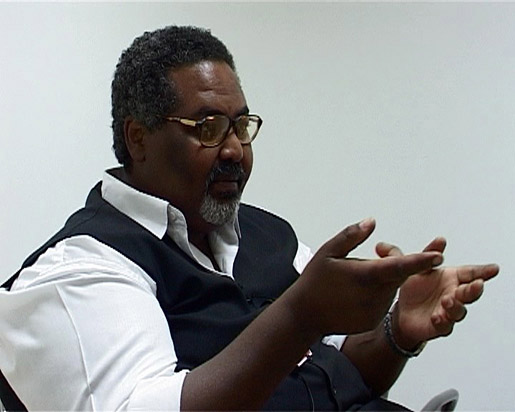
Columbia Journalism Review: Samir Khader, a senior producer for the controversial Arab network, is an equally complex figure, motivated by an apparent mix of cynicism and idealism. “You can’t wage a war without news, without media, without propaganda,” he declares. Khader presses for war coverage that emphasizes its human toll, including casualties inflicted on Iraqi women and children. Nevertheless, the Iraqi-born journalist later confesses that he dreams of moving to America. “Between us,” he says, “if I am offered a job with Fox, I will take it.”

These vignettes lend Control Room an endearing quirkiness that has no doubt contributed to its popularity on the film-festival circuit. But they also underline director Jehane Noujaim’s humanistic message — about the elusiveness of objectivity, the validity of clashing points of view, and the urgent need for the Arab world and the United States to find common ground. A film essay by a journalistic outsider, Control Room focuses on both control of the news and, ironically, lack of control — most evident in the tragic bombing death of an Al Jazeera Baghdad correspondent who may or may not have been targeted by U.S. forces.

Noujaim, a young Egyptian-American filmmaker best known for co-directing Startup.com, majored in both visual arts and philosophy at Harvard, and Control Room is at least partly an epistemological meditation. At its heart is the Qatar-based and financed network that, in its eight brief years of existence, has managed to enrage both Arab dictators (who have frequently censored and suppressed it) and top U.S. officials. In Control Room, Secretary of Defense Donald Rumsfeld is a recurrent hectoring presence, scoring Al Jazeera for “playing propaganda” and neglecting the truth about U.S. involvement in Iraq.

Al Jazeera’s version of the truth has unquestionably won it a big following — 35 million or more viewers — on the so-called Arab street, symbolized in the film by the coffee houses of Doha, Qatar. Launched by former BBC employees, the network, as seen through Noujaim’s lens, defies easy categorization. It features decidedly untraditional female anchors and producers in Western dress, simultaneously translated interviews with non-Arab sources, and a panoply of grisly and unsettling images generally eschewed by the U.S. media: of injured Iraqis, dead U.S. soldiers, and dazed U.S. POWs. Noujaim offers no narration, but her view seems clear enough: If Al Jazeera is biased, its biases are certainly no worse, and no less understandable, than the nationalistic biases of Fox News and other U.S. outlets.
Interview with Jehane Noujaim: "Rail: I imagine reporters at Al Jazeera would definitely be motivated to think about it. But how was Al Jazeera going to help you figure it all out? They were declared enemy propagandists by the U.S., and lots of Arab leaders banned it.

Noujaim: Yeah, but if they’re hated by everybody, there has to be something interesting going on there. The people who go to Qatar, leaving state-run journalism in countries like Jordan and Sudan, to live in a desert in the middle of nowhere… you have to think that these people will be like revolutionaries. I was inspired by these people who are trying to create an understanding on both sides. I’ve spent my whole life trying to bring the two worlds together. Living back and forth between Egypt and the U.S., I was always looking at what one side thinks and then what the other side thinks. There were very different stories being told about the same subject. We forget how perspective means everything. Where you stand, I mean literally stand, means everything. I wanted to make a film about this issue of perspective.

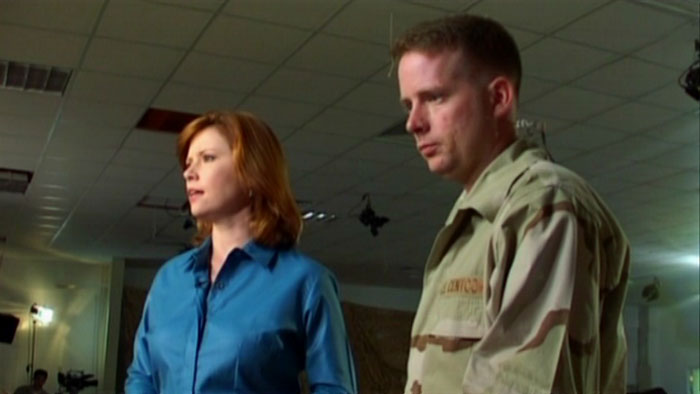
Rail: Interestingly enough, you didn’t end up taking sides with Al Jazeera. You show Lt. Josh Rushing, who is the U.S. military’s press officer also based in Qatar, as a complex character. He speaks about being disgusted when he saw Al Jazeera’s controversial first broadcast of U.S. POWs, until he remembered that he had seen similarly graphic images of Iraqi soldiers killed the night before and hadn’t felt disgusted.

Noujaim: When I was introduced to Lt. Rushing, he basically blasted every stereotype I had about the military. I thought that they wouldn’t be able to talk about how they felt about what was going on. I was very intrigued by him. I knew he would be challenged constantly because his job was to explain the U.S. presence in Iraq to people that were very hostile to it.

He said to me, 'I wouldn’t be able to do this job if I didn’t really truly believe in what I was doing.' And I believed him when he said that. I came to respect him for engaging the other side. He didn’t give flat answers. He talked to Al Jazeera journalists for hours. He didn’t have to do that—he could have given them the military line that he had for that day.

Wednesday, November 23, 2005

This Blog is Five Years Old!


I came across the first post to this blog, on November 11, 2000. You can see it here.

Sunday, November 06, 2005

The Innocents (1961)


Peter's Nite
Pizza, Salad, Fresh Baked Cookies

Note the crossovers with other recent movienites. Jack Clayton also directed Room at the Top. Freddie Francis (DP) shot The Elephant Man. John Mortomer also did the adaptation of Bunny Lake is Missing. Pamela Franklyn (the little girl making her debut) was the manipulative young student in The Prime of Miss Jean Brody.

New York Times Pamela Franklin bio:
Pamela Franklin was born in Japan, where her British father was a busy importer/exporter. Spending her early years in several Far East ports of call, Franklin was bundled off to England to study at the Elmhurst School of Ballet. At age 11, she made her motion-picture bow as the enigmatic "possessed" child, Flora, in 1961's The Innocents. Her American TV debut occurred in the 1963 Wonderful World of Disney two-parter "The Horse Without a Head." There was nothing Disneyesque about Franklin's portrayals of teen murderesses in both 1964's The Third Secret and 1965's Our Mother's House. Her first grown-up role (near-nude scene and all) was as the kidnap victim in Night of the Following Day (1969), but she was back to adolescents in Prime of Miss Jean Brodie (1969) as the rebellious, sexually inquisitive private-school student Sandy. Though still active in TV, Pamela Franklin made her last film in 1976.

Bright Lights Film Journal:
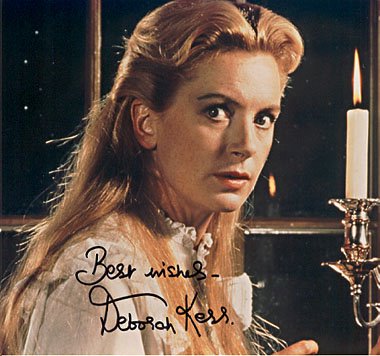
Kerr’s acting, regardless of the role, had always evinced a basic sensuality (it’s what kept her from turning into another Greer Garson), and while it may be hard to believe her Miss Giddens has never engaged in our most basic of mating rituals, it’s very easy to believe that she’s been fixating on them morning, noon, and night.