Sunday, July 24, 2005

The Man in the White Suit (1951)

Stuart's Nite
Thin crust pizza, ice cream, cookies
Screenonline: The Man in the White Suit (d. Alexander Mackendrick, 1951) is perhaps the most cynical, and certainly the most complex, of the Ealing comedies. It was Mackendrick's second film as director, following the surprise success of Whisky Galore! (1949), and the first of two films with Alec Guinness.

Guinness plays Sidney Stratton, mild-mannered but single-minded inventor, whose discovery - an unbreakable, dirt-repelling fabric - threatens an entire industry with ruin. It is perhaps the best of Guinness's string of fine performances for the studio.

As Sidney's only real ally, the industrialist's daughter Daphne, Joan Greenwood is, as she was in Kind Hearts and Coronets (d. Robert Hamer, 1949) and Whisky Galore!, a very untypical Ealing woman: clever, sexy, and manipulative.
The film started life as a stage play, by Roger MacDougall, Mackendrick's cousin. Mackendrick was attracted to the play's premise, that the invention of the fabric causes managers and unions to find common cause in overcoming the threat to their interests. Like his later Ealing films, The Man in the White Suit explores a Britain in which progress is stifled by conservatism and the iron grip of the past. As Mackendrick put it,

"Each character in the story was intended as a caricature of a separate political attitude, covering the entire range from Communist, through official Trades Unionism, Romantic Individualism, Liberalism, Enlightened and Unenlightened Capitalism to Strong-arm Reaction. Even the central character was intended as a comic picture of Disinterested Science."

More than one critic has suggested that Sidney is a stand-in for Mackendrick himself, the free-thinking genius whose vision is held back by the conservatism of the studio hierarchy under Ealing head Michael Balcon. The film does have something of Ealing in its characterisations: Mackendrick reportedly guided Cecil Parker, in his portrayal of the pompous factory boss Birnley, to "model yourself on Mick [Balcon]".

But Sidney's unworldly innocence disguises his disregard for the real social consequences of his actions. The film's most poignant moment comes near the end, when Sidney, pursued by an angry mob, runs into his aged landlady, Mrs Watson (Edie Martin), carrying a basket of laundry. Sidney pleads with her for something to hide his suit, but she rejects him, asking, "Why can't you scientists leave things alone? What about my bit of washing, when there's no washing to do?" Her plea gives Sidney pause but, at the end, he is back to his selfish dreaming.
Alexander Mackendrick: Alexander Mackendrick was born in Boston, Massachusetts in 1912 and grew up in Glasgow, Scotland. In the 1930s, as an art director for the J. Walter Thompson Advertising firm, he designed layouts for a variety of clients including Phillips in Eindhoven, where he worked with George Pal, the Hungarian animator. When the war in Europe broke out, J. Walter Thompson acquired the Ministry of Information as a client to work on propaganda related projects.

In 1941 Mackendrick was sent to North Africa, then Italy as part of the psychological warfare division shooting newsreels and documentary coverage as well as working on leaflets and radio news for the Allied commando effort. When Rome was liberated in 1943, Mackendrick was made director of the film unit and one of the projects he approved was Rome, Open City (Roberto Rossellini, 1945), a film that owes much to its documentary footage. In 1946 he was offered a contract with Ealing Studios, a relatively emerging production company that brought hope for Britain's movie culture by dominating the 1950s with its peculiar brand of comedy.

At the time, British cinema was an unremarkable byproduct of the documentary movement of the 1930s and consisted mostly of literary adaptations. Some comedies were popular, particularly those starring George Formby and other vaudeville mainstays. The wartime population regarded other movies – those incorporating realist techniques from the documentary movement – with sober acceptance. This naturalistic but dull style hindered any progress in the cinema's evolution.

What Ealing Studios brought in was quiet revolution. Films at Ealing were carefully guided under Michael Balcon, the head of production, who exercised authority with a trusting, liberal generosity that challenged the weak traditions of previous filmmaking. The studio was increasingly becoming known for its collegiate atmosphere and democratic, round table conferences that Balcon held, where ideas would be greeted with a kind of paternal affection.

“There are about half a dozen people who claim responsibility for [Mackendrick's arrival at Ealing]” (2), Mackendrick's wife Hilary maintains, yet it seems the circumstances were just of chance. His first job at Ealing was as designer of 'set-ups', or more detailed storyboards that included the characters in proportion to the framing of shots. He then moved on to fully storyboarding and cowriting Saraband for Dead Lovers (Basil Dearden, 1948), along with working on additional dialogue and directing the second unit on The Blue Lamp (Dearden, 1949). In 1948, he was offered a chance to direct the unusual comedy Whisky Galore!. Mackendrick's contribution to Ealing would prove enormous, even if his track record of films would be less so.

Mackendrick's second film, The Man In The White Suit (1951), is the best of his Ealing comedies. A scientist currently working as a lab janitor discovers the formula for an indestructible type of fiber but finds himself under opposition from both the unions and executives of the textile industry. The story, based on a play written by Mackendrick's cousin Roger MacDougall, owes little to its source material. The issue that the director was concerned with was the polemics of industry and its responsibilities. The result is a deeply pessimistic portrait that challenges values and obligations of business and society, and is not so much a light comedy as a cautionary tale to the excess of idealism. Before facing white and blue collar opposing forces, the inventor, Sidney (Alec Guinness), is initially keen on the benefits of his discovery. Like the naive Waggett in Whisky Galore!, the consequences of one character's inexperience results in changes that affect the whole community.

Stylistically, the movie pays small homage to Fritz Lang, and is strikingly photographed by frequent collaborator Douglas Slocombe. Sidney whips through dark alleyways, wearing the pristine suit, and several union members dirtily paw at it, the expressionist claustrophobia apparent. Stony black-suited monolithic executives also hover over him throughout the film, observing his moves with a jealous superiority reminiscent of the vigilante jury from M (1931).

The casting of Alec Guinness as Sidney was a coup for Mackendrick, as his indistinctive appearance permits him to be regarded more as a vehicle of idealism, untouched by pressures of consumer society. The austere businessmen of the textile industry portray a ripe parody of establishment as fatuous capitalists. They are afraid of change and attempt to hold on to legacy and tradition; essentially, the crumbling facade of English imperialism. But even Sidney, maladroit and innocent, is doomed to failure. His priorities shift throughout the picture: idealism turns into opportunity and action, reality becomes experience, but he remains ambiguous.

The characters however, are never polar opposites, and only divide in matters of personal ethics. Sidney, Mackendrick emphasized, is not “pure” (3), and is as devious and self-interested as the industry men who try to stop him. This is the most destructive quality of his innocence. He doesn't have the experience of the executives to realize the effect on the community. Perhaps it is his childlike approach to the situation that warrants sympathy, and a quest for some kind of absolute. But there is no universal answer. The result becomes cynicism and frustration in the mechanics of a comedy.

Mackendrick bio: Alexander Mackendrick was born in Boston, Massachusetts on 8 September 1912, the only child of a shipbuilding draughtsman and civil engineer, Francis Robert Mackendrick, and his wife Martha, who had migrated to the USA from their native Glasgow in the previous year. When Alexander was only six years old, his father died in the post-World War I influenza epidemic, and his mother, attempting to pursue a career as a dress designer, gave the boy over to his grandfather, who took him back to Glasgow in 1919. He was never reunited with his mother, and later in life realised that his childhood had been lonely and rather unhappy.

After attending Hillhead High School between 1919 and 1926, Mackendrick enrolled at the Glasgow School of Art for three years before moving to London to take up a job at the advertising agency J. Walter Thompson (JWT). He was soon promoted from layout artist to art director and he remained at JWT throughout the 1930s. Characteristically, he said of the early years of his career that his training in advertising had been invaluable, "though it's an industry I in effect despise". During this period he co-wrote a script with his cousin Roger MacDougall, which was bought by Associated-British and released under the title Midnight Menace (d. Sinclair Hill, 1937). Between 1936 and 1938, he also scripted and storyboarded five cinema commercials for Horlicks, which were shot in Technicolor by the stop-puppet animator George Pal.

During the early years of World War II, Mackendrick scripted and storyboarded wartime propaganda films for a new animation unit at JWT headed by John Halas and Joy Batchelor. In 1942, he and MacDougall set up their own production company, where Mackendrick cut his directorial teeth with three ninety-second 'instructional' films to be inserted into the Pathé Gazette newsreel. In the following year, he travelled to Algiers and Italy with the Army Psychological Warfare Branch (PWB), drawing cartoons for Allied propaganda leaflets. After the fall of Rome he and the art director Peter Proud directed two documentaries, I granai del popolo (a propaganda piece aimed at persuading Italian farmers to make surplus grain available for general distribution) and Le fosse Ardeatine (on the aftermath of the Nazis' massacre of partisans at the Fosse Ardeatine in Rome).

When the war ended, Mackendrick set up Merlin Productions with MacDougall, making documentaries for the Ministry of Information. When the company ran into financial difficulties, Mackendrick sought work at Ealing Studios and in 1946 was taken on as scriptwriter and production designer on Basil Dearden's Saraband for Dead Lovers (1948). This was the start of a new phase in his career: he stayed at Ealing for nine years, directing five films, establishing himself as a key figure in Britain's post-war film industry and acquiring a considerable international reputation.

The Man in the White Suit (1951), Mackendrick's next assignment, was based on a play by MacDougall about the invention of an indestructible cloth by a scientist working for a textile mill: in the film the scientist, Sidney Stratton (Alec Guinness), is an idealist who regards his invention as potentially revolutionary. One of Mackendrick's dangerous innocents, Stratton fails to take account of the less positive aspects of his brainchild; and it is his lack of awareness that provides the source of the comedy. In Charles Barr's view, "perhaps the most intelligent of British films [and] certainly one of the most complex", The Man in the White Suit is stamped with its director's mordant humour and displays degrees of irony and ambiguity exceptional even for Mackendrick.

Roger Macdougall, cousin of Alexander Mackendrick worked in films first as composer, then writer; at Ealing as writer intermittently between 1939 and 1953, meanwhile working for several years in the 1940's as writer and director of documentaries for his own Merlin productions. Continued writing for the stage, occasionally for films; The Mouse that Roared (1959).
Joan Greenwood: Chosen by Empire magazine as one of the 100 Sexiest Stars in film history (#63).

Encyclopedia of British Film: The irresistible leading lady of some of the most enduring British films, seductive of voice, face and figure, searching the language - and indeed the world - for booby traps, Greenwood's performance record must be nearly unrivalled among British leading ladies. RADA-trained and on stage from 1938 (delectably malicious as Hattie in The Grass Is Greener, 1959; sharply ambiguous in The Chalk Garden, 1971), she was in films from 1940.

She was one of The Gentle Sex (1943) celebrated in Leslie Howard's film, was a sympathetic helper for The October Man (d. Roy Ward Baker, 1947), and a doomed Sophie Dorothea in Saraband for Dead Lovers (d. Basil Dearden, 1948), but it was as the female lead in a series of benchmark comedies that she made herself indispensable to British films.

In Whisky Galore! (d. Alexander Mackendrick, 1949) and Kind Hearts and Coronets (d. Robert Hamer, 1949), she is the drily beguiling Peggy and the wonderfully minxish Sibella respectively; she deflects Alec Guinness from his experiments in The Man in the White Suit (d. Alexander Mackendrick, 1951, 'What could I do?' she asks, as if it wasn't obvious) and she is, in her way, as imperishably Gwendolyn as Edith Evans is Lady Bracknell in The Importance of Being Earnest (d. Anthony Asquith, 1951).

She did better in America than some of her contemporaries (cf. Moonfleet, d. Fritz Lang, 1955, and Stage Struck, d. Sidney Lumet, 1958). She played character roles back in Britain but remained a star till the end, which came after Little Dorrit (d. Christine Edzard, 1988), as Mrs Clennam, and it was good to see her brilliant at the finish. There was some TV and stage work but she is above all a British film star, the genuine article.

Never, it seems, very ambitious, she had a late but happy marriage to actor André Morell and worked only fitfully after that.
Alec Guinness, best known and most loved British actor of the 20th century, made 77 films over nearly 50 years, beginning in 1946 and 1948 with David Lean’s Great Expectations and Oliver Twist, and continuing beyond the Star Wars Trilogy to A Passage to India in 1984 and later films for television . He brought to the screen timeless qualities of comedy brilliance, an individual sense of the eccentric and the macabre, and an inner reality of character which has rarely been surpassed. Although he began as a stage actor, the cinema transformed his career, proclaiming his phenomenal range and bringing him world-wide recognition. He became the supreme entertainer about whom there always remained something unknown: this sense of an impenetrable secret, of something deliberately hidden - also maintained carefully in his personal life - became the key to his continuing fascination. All his films are full of his special genius.

After the two Dickens films, when Ealing Studios resumed film-making after the war, Guinness quickly rose to become its leading star with Kind Hearts and Coronets and The Lavender Hill Mob. He stayed mainly with Ealing for the next five or so years, but came to tire of the idea, projected in the comedies, of himself as the master of a hundred faces. From then on his range broadened to central dramatic roles, saints, men of genius, leaders, spies and master-criminals, all distinct and observed with his ironic sense of detachment.

Guinness was always a very subtle performer, with a meticulous attention to detail, and an extraordinary power of concentration. As his talent and career burgeoned he became not so much interested in big effects, but paring away everything that was inessential. His mastery of expressing hidden feeling, of being tortured and of mental suffering, emerged fully in The Prisoner, in which he played the persecuted Roman Catholic Cardinal, and in The Bridge on the River Kwai, for which he deservedly won an Oscar for best actor. In many of his films there emerges the sense of a personal quest, of a search for identity, as he successively disappeared and re-emerged completely disguised as fictitious people, or as, say, Hitler, Freud, Charles I or Marcus Aurelius. His Fagin, with its ferocious display of evil, was censored in parts of the U.S.A. for being anti-Semitic; his Fuhrer provoked a ban in Israel for its human sympathy- but he maintained in both cases he never minded thoroughly evil people, whom he found more interesting to act than good ones.

While he was occasionally courted by avant-garde and art directors, he stayed in the mainstream of popular cinema, although he occasionally engaged in ventures of his own, for instance when he produced, and played Gulley Jimson, in his own adaptation of The Horse’s Mouth. Given his five years wartime experience in the British navy he played many and varied serving officers, the best of which was the hard-swearing, hard drinking Jock Sinclair in Tunes of Glory. You rarely see Guinness, in this extraordinary wide variety of films in the NFT programme, letting himself rip, but Tunes of Glory is the glorious exception. With the advent of the British obsession with spies it took little for Guinness to become supreme in this field as Smiley in the two Lé Carre series made for television.

Mackendrick's first film at Ealing, Whisky Galore! (1949), ranks high among the comedy classics of British cinema. Based on Compton Mackenzie's novel about a shipwrecked cargo of whisky off the Hebridean islands, the film focuses on disagreements between the inhabitants of the island of Todday and officialdom (in the form of the Englishman in charge of the island's Home Guard) about what should be done with the whisky. In a variant of a theme which was to surface repeatedly in Mackendrick's work, the Englishman represents Innocence, the islanders Experience. But in Mackendrick's world, oppositions are rarely clear-cut and humour is always double-edged: in Whisky Galore! innocence is potentially dangerous, experience devious and exploitative.

Two qualities distinguish Guinness as unique. First the so-called anonymous face, sometimes defined as that of the man in the street, yet which can turn into anyone’s: as George Lucas said of him, 'Like a chameleon, Alec has a lot of different shades, different colours and different characters'. Second, he always avoided finding the permanent, comfortable role. No striking effects, no direct emotional statements, an eavesdropping style easy to overlook.
-- Garry O’Connor, Author of 'Alec Guinness the Unknown: A Life

Household fame, though, came with films. An extra in Evensong (d. Victor Saville, 1934), he didn't film again until his beautifully exact Herbert Pocket in David Lean's Great Expectations (1946), followed by his controversially repulsive Fagin in Oliver Twist (1948) and the series of Ealing comedies with which, to this day, his name is most tenaciously associated. (Except of course by the very young who know him only as Obi-Wan in Star Wars (US, d. George Lucas, 1977), for which he famously took a percentage and needed never to work again.)

There are seven of these comedies, most memorable of which are the immaculate Kind Hearts and Coronets (d. Robert Hamer, 1949), in which he played eight members of a ducal family, The Lavender Hill Mob (d. Charles Crichton, 1951), as the mild bank clerk dreaming larcenously of gold bars, The Man in the White Suit (d. Alexander Mackendrick, 1951), as an inventor in the grip of an idée fixe, and The Ladykillers (d. Mackendrick, 1955), as the unctuous, snaggle-toothed leader of a gang of incompetent crooks. In 1989, he claimed never to feel comfortable playing characters too like himself, and most of these films allow physical disguise to complement the inner obsessions. His own physical appearance as a young man was pleasantly ordinary rather than glamorously film starrish.
Ealing Studios can claim to be the oldest film studio in the world. The stages and offices are steeped in history having survived the onset of the talkies, two world wars and the more recent technological advances in film and TV.

Will Barker, a pioneer of British cinema, originally acquired the site in 1902. Basil Dean, owner of Associated Talking Pictures took over from Barker in the early 1930s and Ealing Studios was established. In 1938, Michael Balcon joined Dean as Head of Production. The golden era of Ealing Studios had begun.

This fabulous period of creativity would last until the late 1950s. Films like the Ladykillers, The Lavender Hill Mob, Passport to Pimlico and Kind Hearts and Coronets were created and formed the pinnacle of the most astonishing British film production ever seen.

The BBC bought the Studios in 1959 and they spent the next 20 years creating television productions from Ealing Studios such as Colditz, The Singing Detective and Fortunes of War.

The Studios were acquired in mid-2000 by Uri Fruchtmann, Barnaby Thompson, Harry Handelsman and John Kao. Together these partners aim to rebuild the Studios with a vision that brings film, technology and property expertise together in order to revive and continue the outstanding quality of past productions made here at Ealing.

Ealing Studios has recently accommodated high profile films including An Ideal Husband, Notting Hill, Star Wars – Episode 2, Lucky Break and The Importance of Being Earnest. Recent television productions include The Royle Family (Granada), Bedtime (HatTrick), Randall and Hopkirk Deceased (Ghost) and Emma Brody (20 Century Fox).

More on Ealing: It was a place in which the editor was highly regarded, and nearly all Ealing's directors had served earlier in the cutting-rooms - Charles Crichton, Charles Frend, Henry Cornelius, Thorold Dickinson, Robert Hamer, Leslie Norman, Michael Truman and Seth Holt were all former film editors. A much smaller number had graduated from screenwriting - this group included Basil Dearden, Harry Watt and Alexander Mackendrick. But significantly no actors were ever elevated to a directorial role. Ealing operated almost on a repertory basis, with a number of reliable performers appearing again and again, no doubt attracted as much by the idea of regular work as of contributing to the product of a much-favoured British studio. But Ealing, good as it was for reputations, was no place in which to get rich.
Sidney Stratton Lives! PALM SPRINGS, Calif., Feb. 12, 2002 - To show that nanotechnology is more than hype, David Soane stands before an audience of about 250 people at a nanotech investing forum, and holds up a pair of beige cotton slacks.

Molecular structures that are part of the Nano-Texprocess are much smaller than a grain of sand or even a virus. That prevents the human eye, or touch, from detecting even a minor difference between Nano-Tex fabric and regular fabric, the company says.
"This is a pair of pants," Soane says casually. "You can buy them in any Eddie Bauer," the retail chain with a store even in Palm Desert, Calif. That's not far from the table where Soane picks up a glass with liquid in it.

"Imagine you're at a cocktail party and you have red wine..." Soane empties the glass on the fabric. The liquid rolls off. "One hundred percent cotton," the Berkeley chemical engineering professor-turned-entrepreneur says triumphantly.

Sunday, July 17, 2005

Room at the Top (1959)

Peter's Nite
Salad, Pizza, Carrot Cake, Ice Cream

Review: "In this striking debut from director Jack Clayton, who never again achieved at this level, Lawrence Harvey plays a small-town man who comes to the city to make it big. Harvey, he of the shark face and empty eyes, is coldly charming, and quickly wins the admiration of those who are unable to see through the blustery exterior to the cold inside. He sets his sights on Susan (Heather Sears), the daughter of a local bigshot: the movie is about his calculated efforts to win her over against her uppity family's resistance. In the meantime, he starts an affair with Alice (Simone Signoret), a member of a theater group he joins in order to get closer to Susan, the heiress.

Alice is ten years older and infinitely wiser than Susan, but she falls for Joe anyway, probably because he is open and honest with her. Joe starts to fall for her too, complicating his plans. He must choose between the love of his life, which turns out to be Alice, and what he thought he wanted, represented by Susan."

Screenonline: "It is difficult to categorise Jack Clayton's work as a film director. Given that all of his feature films were adapted from novels, he could be seen as the most literary of British film-makers, and yet he was also deeply committed to using all the resources offered him by cinema. His films were always carefully crafted but they also contained moments of spontaneity and rawness.

This craftsmanship earned him the respect of his fellow film-makers but - with the notable exception of Room at the Top (1959), which in many ways was his least typical film - he rarely enjoyed substantial commercial success. A director of remarkable talent, Clayton's uncompromising independence led not just to a relatively small output - with only eight feature films completed in his entire career - but also to his often being out of step with what the market, and sometimes also the critics, wanted."
John Braine: "John Braine was born in Bradford in 1922 and spent much of his early life at Thackley near Shipley. In 1933, he won a scholarship to St Bede’s Grammar School but he was not an academic success and left in 1938 without a School Certificate.

He took various minor jobs, finally settling at Bingley Library as a librarian until, in 1942, he was drafted into the Royal Navy where he trained as a wireless telegraphist. Before he could find active service, he was invalided out of the Navy, suffering from tuberculosis, and was sent to convalesce at the sanatorium at Grassington, in the Yorkshire Dales.

When he was discharged, he resumed his position at Bingley Library and finally passed his School Certificate in the summer of 1944. In 1947, he attended Leeds School of Librarianship, returning to Bingley as Senior Assistant Librarian. Whilst living and working there, he became involved in the Bingley Little Theatre, an experience that was to provide inspiration for themes in Room at the Top and other novels that he later wrote.

Determined to become a writer, Braine left his job at Bingley in 1951 and went to live in London. He did some writing for Lilliput, The New Statesman, and Tribune, but his early days as a writer were a desperate struggle and for a time he lived in poverty, finally returning to Bradford in November 1951 for the funeral of his mother. Shortly afterwards, his health deteriorated and he was re-admitted to Grassington Sanatorium for eighteen months. It was whilst he was there that he developed an idea for a novel based on a verse play he had written called The Desert in the Mirror, inspired by the theme of Faust, about a young man who sells his soul for riches. The novel’s original working titles were Born Favourite and Joe for King. Shortly before it was published – and having encountered the obligatory publishers’ rejection that most gifted writers seem to face, as though their talent cannot be judged – Braine wrote gloomily:

“I was a failure at the age of thirty-five, not even able to provide a home for my wife and the coming child. And the novel on which I had pinned my hopes had been rejected by four publishers.”

When the novel that he had written in longhand in his hospital bed was finally published in March 1957 as Room at the Top, it became an overnight success, thrusting John Braine onto the international stage and bringing him fame and fortune.

He went on to write a dozen novels over the next thirty years, as well as TV adaptations of his later books, and two non-fiction works, J B Priestley, and Writing a Novel. His second novel, The Vodi, drew heavily on his time spent as a tuberculosis patient at Grassington. His fourth novel, The Jealous God, was also strongly autobiographical.

John Braine died in October 1986. Grassington Sanatorium was demolished several years ago to make way for an executive housing development. Room at the Top has never been out of print."
In "What Would a Writer Do?" John Braine reminds writers that they must give considerations of “self” over to the work: “You must realize that you yourself don't matter. Only the work matters” (48). All serious writers understand this concept as an element of the process, the writer's working for an altered state of concentration. The problem for the teacher is how to induce it so that students can experience writing in the way writers do.
Screen On Line: "Room at the Top, released at the beginning of 1959, was the first of the 'new wave' films. It came from established industry producers, John and James Woolf, and was a huge box-office hit. This success opened up new possibilities for British filmmakers. Audiences had proved they were prepared to see adult storylines, gritty realism and political comment, and so the new wave as a commercial proposition was born. War films and romantic comedies dried up and the provinces and proletariat were suddenly discovered.

As a trailblazer which had a big impact on the British film industry and its audience, Room at the Top has inevitably faced a backlash. After an initial consensus that it was daring and different, a new consensus emerged that it was stolid and indifferent.

Maybe it's time for the backlash against the backlash, for there are many fine things in Room at the Top. It may lack the punch of Saturday Night and Sunday Morning (d. Karel Reisz, 1960), the lyricism of A Taste of Honey (d. Tony Richardson, 1962), the humour of Billy Liar (d. John Schlesinger, 1963) or the depth of This Sporting Life (d. Lindsay Anderson, 1963), but it has the virtues of a direct challenge to national complacency and a searing emotional honesty about personal relationships.

No other new wave film takes on the class system as boldly. It offers a complex analysis of class warfare that challenges the accepted state of things in Britain at the time. Joe is proud of his class but, unlike Arthur Seaton in Saturday Night, keen to leave it. The only way to do this is by cold calculation and emotional manipulation."
Simone Signoret (March 25, 1921 - September 30, 1985), was a French actress.

"She was born Simone-Henriette-Charlotte Kaminker in Wiesbaden, Germany to Andre and Georgette (Signoret) Kaminker. She was the oldest child of three, with two younger brothers. Her father was a French army officer and a linguist who later worked in the United Nations. She grew up in Paris in an intellectual atmosphere and studied the English language in school, earning a teaching certificate. She tutored in English and Latin and worked part-time as a typist for a French newspaper.

During the German occupation of France, Signoret formed close bonds with an artistic group of writers and actors who met at a local cafe. By this time, she had developed an interest in acting and was encouraged by her friends to follow her ambition. In 1942, she began appearing in bit parts and was able to earn enough money to support her mother and two brothers as her father, who was Jewish, fled the country. She took her mother's maiden name for the screen to help hide her Jewish roots.

Signoret's sensual features and earthy nature led to type-casting and she was often seen in prostitute roles. She won considerable attention in La Ronde (1950), a film which was banned briefly in New York state as being immoral. She won further raves, including an acting award from the British Film Academy, for her portrayal of yet another prostiute in Jacque Becker's Casque d'Or (1951). She went on to appear in many notable films in France during the 1950s including Therese Raquin (1953), Diabolique (1954), and The Crucible (1957).

In 1958, Signoret went to England to film Room at the Top (1959), which won her numerous awards including the Academy Award for Best Actress. She was the first woman to win the award appearing in a foreign film. She was offered films in Hollywood but turned them down and continued to work in France and England. She did return to America for Ship of Fools (1965) which earned her another Oscar nomination and she went on to appear in several Hollywood films before returning to France in 1969.

In her later years, she was often criticized for gaining weight and letting her looks go but Signoret, who was never concerned with glamour, ignored the insults and continued giving finely etched performances. She won more acclaim for her portrayal of a weary madam in Madame Rosa (1977) and as an unmarried sister who unknowingly falls in love with her paralyzed brother via anonymous correspondence in I Sent a Letter to my Love (1980)."

Chains do not hold a marriage together. It is threads, hundreds of tiny threads, which sew people together through the years.
-- Simone Signoret
"Laurence Harvey was born October 1, 1928 in Joniskis, Lithuania. His real name was Laruschka Mischa Skikne, which he changed when his parents emigrated to South Africa to escape persecution for their Jewish faith, when he was five years old. At 15, he debuted on stage with the Johannesburg Repertory Theater, but later he joined the army and served until the end of WWII.

He went to England after the war and enrolled at the Royal Academy of Dramatic Art, staying there three months before joining a Manchester repertory company where he soon began to play leads. He was married three times first to Margaret Leighton in 1957, then to Joan Cohn in 1968 and then to Pauline Stone in 1972. They had one daughter named Domino. After his breakthrough film Room at the Top in 1959, Hollywood again took interest in Harvey, and in 1960 he co-starred with John Wayne in The Alamo, followed by an appearance in the Elizabeth Taylor hit Butterfield 8. A role in the 1961 British production The Long and the Short and the Tall was next, trailed by a pair of Hollywood flops, Two Lovers and Summer and Smoke. Finally, in John Frankenheimer's masterful The Manchurian Candidate, he found a role perfectly suited to his talents, portraying a brainwashed assassin shorn of emotion; the performance was the best of his career, but in a cruel twist of irony the film was pulled from distribution by producer/star Frank Sinatra when its plot too closely foreshadowed the tragic death of President John F. Kennedy. He worked steadily until his death from stomach cancer at his home in Hampstead, London, in 1973."

Tuesday, July 12, 2005

"Why Not Hillary?"

"Why Not Hillary?" by Carl M. Cannon: "If Hillary Rodham Clinton were to run for president in 2008, how likely would you be to vote for her—very likely, somewhat likely, not very likely, or not at all likely?

Very likely 29%
Somewhat likely 24
Not very likely 7
Not at all likely 40
No opinion 1

At the risk of laboring the point, 29 percent plus 24 percent adds up to a majority. I can hear my pals answering this as they read these numbers: “Yes, but that's before the conservative attack machine gets a hold of her...'

Well, no, it isn't. They've been going at her with verbal tire irons, machetes, and sawed-off shotguns for 12 years now. "

Read the story here. Or, for the contrary POV, there's this. All right. I promise I'll leave politics alone. For the moment. Back to work.

Via Washington Monthly.

Monday, July 11, 2005

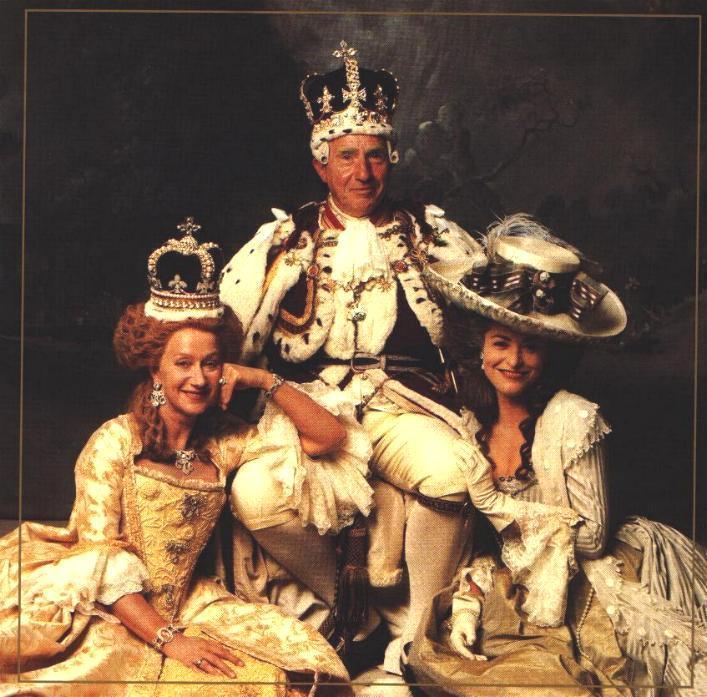
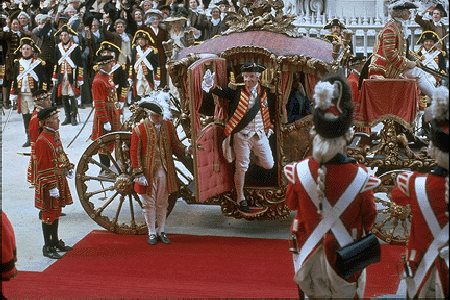
The Madness of King George (1994)

Nora's Nite
Hamburgers, Ice Cream, Cookies

Sir Nigel Hawthorn, 1929-2001

From an obituary:
"IN 1990, I SAT IN BROADWAY'S Brooks Atkinson Theatre and watched a 61-year-old British actor whom I had never before seen perform the hell out of the lead role of C.S. Lewis (author of the Narnia books) in William Nicholson's Shadowlands. A confirmed British bachelor, Lewis finally found true love with a younger American divorcee, only to have her die before her time. Toward the end, Hawthorne had a monologue that transformed seamlessly into a pained declaration of raw grief. It was a masterful display of profound sadness and controlled rage. Later, the openly-but-quietly gay Hawthorne shared that it had been fueled by his own prolonged nightly vigil at the deathbed of a dear friend dying from AIDS.

Despite a Tony Award for the role, Richard Attenborough cast the more bankable Anthony Hopkins in his 1993 film version. Though I kept waiting to compare the two men in the climactic speech, it never came. A casualty of the screen trans­lation. All te better for now it belongs to Hawthorne and to those who were lucky enough to bear witness.

Nigel Hawthorne was a steadily working actor for 40 years' before Shadowlands. He had a significant British stage resume and achieved popular success starring in the hit British comedy series, Yes, Minister, and its follow-up, Yes, Prime Minister, both of which played to PBS audiences in the States. But it wasn't until Alan Bennett insisted that Hawthorne recreate his stage triumph in the title role of the 1995 film adaptation of his play, The Madness of King George that Hawthorne truly became known on the interna­tional scene. In the U.S., his royally insane portrayal brought him a Best Actor Oscar nomination, the first for an openly gay actor." LINK
George III
"In 1810, George became dangerously ill, the malady possibly having been triggered by the death of the King's youngest and favourite daughter, the Princess Amelia, from erysipelas or porphyria. By 1811, George III had become permanently insane and locked away at Windsor Castle until his death. Sometimes speaking many hours without pause, he claimed to talk to angels and once greeted an oak tree as King Frederick William III of Prussia. His doctors gave him James's Powder (calomel and tartar emetic) and bled him regularly. They also advised him to bathe in the sea (thus encouraging public seaside vacations).

Parliament then passed the Regency Act 1811, to which the Royal Assent was granted by the Lords Commissioners (who were appointed under the same irregular procedure as was adopted in 1788). The Prince of Wales acted as Regent for the remainder of George III's life.

Spencer Perceval was assassinated in 1812 (he was the only British Prime Minister to have ever suffered such a fate) and was replaced by Robert Banks Jenkinson, 2nd Earl of Liverpool. Lord Liverpool oversaw British victory in the Napoleonic Wars. The subsequent Congress of Vienna led to significant territorial gains for Hanover, which was upgraded from an electorate to a kingdom.

Meanwhile, George III's health deteriorated. Over the Christmas of 1819, George suffered a further bout of madness and spoke nonsense for fifty-eight hours, then sank into a coma. On 29 January 1820, George died blind, deaf, and insane at Windsor Castle. By the time of his death, George III had lived for over eighty years and reigned for almost sixty years—in each case, more than any other English or British monarch until that point. Neither record has been surpassed by any monarch since, with the exception of Victoria. George III was buried on 16 February in St. George's Chapel, Windsor.

George was followed by his eldest son (who became George IV). Next came another of George III's sons, who became William IV. William IV, too, died without children, leaving the throne to his niece, Victoria, the last monarch of the House of Hanover." Via Wikipedia
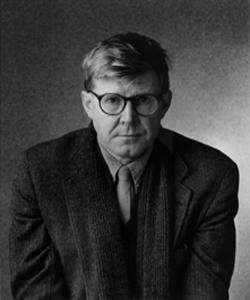
Alan Bennett
"Alan Bennett has been a household name in British theatre ever since he starred and co-authored the satirical review Beyond the Fringe with Dudley Moore, Peter Cooke and Jonathan Miller in 1960 at the Edinburgh Festival. Later the same show played to packed houses in London's West End and in New York. Although Bennett started by writing and acting for the stage, he very soon turned his attention to writing plays for television.

Bennett's career, though less spectacular than those of his Fringe companions, has displayed greater diversity and more solid achievement. To many he is now regarded as perhaps the premier English dramatist of his generation. This is all the more surprising given the low-key themes and understated expression of the "ordinary people" who populate his dramatic world. Like the poetry of Philip Larkin, another Northerner whose writings he admires, his writing frequently focuses on the everyday and the mundane: sea-side holidays, lower-middle class pretensions, obsessions with class, cleanliness, propriety and sexual repression." LINK
"The Madness of King George spreads its story on a broad canvas: the court of a troubled King who is seized by what seems to be dementia. As George III (Hawthorne) loses control, the foppish Prince of Wales (Rupert Everett) plots to seize the throne, while Prime Minister William Pitt (Julian Wadham) fights to retain his power. But at its heart King George is an intimate family drama. It can be seen as satirical parable - "The film is really as much about the royal family today as it is about the 18th century," says Bennett - or as domestic tragedy, a kind of Mr. and Mrs. King Lear. Father is slipping away; what are Mother (Mirren) and the children to do?

George could also be a failed Alan Bennett. "My films are about embarrassment," he says. "George III, for one, is nervous and shy, like many royals. His bluntness and heartiness proceed from social unease. But his role is to present himself as King. When madness sets in, he drops this facade; he isn't embarrassed anymore. Embarrassment is a continuing theme in my work. I can't say I'm George III, but I certainly understand him!" Alan Bennett Interview

Friday, July 01, 2005

MovieNite Celebrates Canada Day!

"Canada Day (French: Fête du Canada) is Canada's national holiday. It is celebrated on July 1.

It celebrates the creation of the Dominion of Canada through the British North America Act 1867, which came into effect on July 1, 1867, uniting three British territories — the Province of Canada (southern Ontario and southern Quebec), Nova Scotia, and New Brunswick — into a federation.

The holiday itself was formally established in 1879 and was originally called Dominion Day, making reference to the Canadian-originated term 'dominion' to describe the political union, at a time when the Fathers of Confederation were hesitant to use a name such as the Kingdom of Canada. The name was changed to Canada Day on October 27, 1982."

Via Wikipedia
LINK

Monday, June 27, 2005

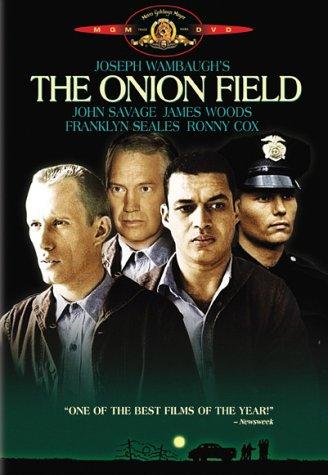
The Onion Field (1979)

Pamela's Nite
Elaborate Salad, Fresh Bread, Strawberry Cheesecake


Joseph Wambaugh Interview
"BRC: You've written four other nonfiction works and eleven works of fiction. Do you enjoy writing one more than the other?

JW: I enjoy doing the research of nonfiction; that gives me some pleasure being a detective again and doing investigation. When all is said and done, though, I'm not sure. When I look back I think maybe the novels contain more of my DNA, I carried them like a mother carries a child. I delivered them. The nonfiction story belongs to other people and doesn't carry much of my DNA. They're like foster children.

Except for THE ONION FIELD. That one got pretty close to me because I was a cop when it happened. I saw some of the indifference that my police department showed to the surviving officer. I was just a young cop when he was fired from the department as a thief and a crook. I found out he was shoplifting and I started asking questions back then. People described his shoplifting. I wasn't a writer then --- or maybe I was a writer but didn't know it --- but I said, wait a minute, this sorta sounds like guilt crying out for punishment. Something is going on here. I felt like a part of that one. It felt more like a novel to me than nonfiction.

BRC: Without question, THE ONION FIELD has become a literary classic. Was that book the pivotal moment when you knew you had to make a choice between writing and police work?

JW: I wrote two fiction novels before I wrote THE ONION FIELD, but I was still a cop. When I wrote THE ONION FIELD, I realized that my first two novels were just practice. THE ONION FIELD made me a real writer. And then I knew it was over, I couldn't be a cop anymore."
Update
June 13, 2005 'The Onion Field' Killer Busted for Heroin
Jimmy Lee Smith, who served 19 years in prison for the kidnapping of two Los Angeles police officers and the murder of one of them in "The Onion Field" case of 1963, may be headed back to prison for possession of heroin while on parole.
LINK

Friday, June 24, 2005

Studios target older, richer DVD buyers

What happens when the theatrical model moves away from the the DVD model -- what happens when the movies that score in the theater, bomb on DVD -- will this change the mix of studio movies? They've been making movies for 14 year olds for so long, could this change the culture? Probably not.
Studios target older, richer DVD buyers - Yahoo! News: "...two of his studio's biggest overperformers for the year, 'Ray' and 'Friday Night Lights,' generated staggering DVD sales numbers in large part because of high demand from older consumers. 'Ray' earned nearly $150 million from DVD sales and rentals, twice its box office, while 'Friday Night Lights' took in $100 million against a theatrical gross of just $60 million.

'Look at how this works when you hit them with the right product,' Kornblau said. 'You're seeing it over and over again -- the biggest overperformers are titles that hit the older demographic.'"

Wednesday, June 08, 2005

Testament of Dr. Mabuse, The (1933)

Stuart's Nite
Pizza, Substitute Ice Cream

'You have no existence except as my tool. The individual has no being except insofar as he is part of a machine. The individual is nothing; the machine is everything.'
— Dr. Mabuse, The Crimes of Dr. Mabuse
Fritz Lang Interview: How did you come to leave Germany at the height of your career and seek refuge outside the country?

I had made two Mabuse films and the theatre had asked me if I could make another one because they made so much money. So I made one which was called The Last Will of Dr Mabuse (1932).

I have to admit that up to two or three years before the Nazis came I was very apolitical; I was not very much interested and then I became very much interested. I think the London Times wrote about the fact that I used this film as a political weapon against the Nazis - I put Nazi slogans into the mouth of the criminal.

I remember very clearly one day, I was in the office and some SA men came in and talked very haughtily that they would confiscate the picture. I said if you think they could confiscate a picture of Fritz Lang in Germany then do it, and they did. I was ordered to go and see Goebbels, and they were not very sympathetic to me, but I had to go, maybe to get the picture freed, so I went.

I will never forget it - Goebbels was a very clever man, he was indescribably charming when I entered the room, he never spoke at the beginning of the picture. He told me a lot of things, among other things that the 'Fuhrer' had seen Metropolis (1926)and another film that I had made - Die Niebelungen (1924) - and the 'Fuhrer' had said 'this is the man who will give us THE Nazi film.' I was perspiring very much at this moment, I could see a clock through the window and the hands were moving, and at the moment I heard that I was expected to make the Nazi movie I was wet all over and my only thought was 'how do I get out of here!'. I had my money in the bank and I was immediately thinking 'how do I get it out?' But Goebbels talked and talked and finally it was too late for me to get my money out! I left and told him that I was very honoured and whatever you can say. I then went home and decided the same evening that I would leave Berlin that I loved very much.
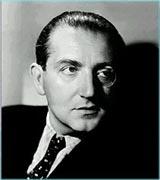
The Permanent Magic of Fritz Lang: Fritz Lang was born in Vienna in 1890 and died in California in 1976. His life took in service in the First World War, spectacular fame in Germany in the 1920s, escape from the Nazis, and an often difficult period of reinvention in Hollywood. Famous for his autocracy and brutal treatment of actors, he was even dogged with the rumour that he had murdered his first wife. Others, of course, delighted in his company. Either way by the time of his death he was a legend.

His career coincided almost exactly with Alfred Hitchcock's, and the comparison between the two directors is often made. Both thrived in silent film, but easily adjusted to sound. Both moved from Europe to America and recreated their genius in a new culture. Yet while Hitchcock is instantly recognisable and his films are easily seen, Lang's work and reputation are much more obscure. Though no critic would question Lang's stature there's no consensus about which of his films are masterpieces. And substantial scholarly work on Lang is astonishingly scarce. David Thomson, in his Biographical Dictionary of Film, even says that 'Lang's adult stories are too concentrated for today's standards'. But this is too much of a simplification.

Lang was an extraordinarily varied and resourceful director. He was able as much as any other director to turn his hand to virtually all genres. In the 20s he made large-scale, expansive films, which often tested the limits of the silent cinema. Big-budget, epic, aimed at the mass audience, with the best special effects available at the time, Lang's world in the pre-sound era was peopled by spies, dragons, legendary heroes, dictators, master criminals and futuristic demagogues.

Tuesday, June 07, 2005

Bigger doesn't mean safer

SUV occupants more likely to be killed:

"In a two-vehicle crash with a smaller car, the occupants of the SUV are more likely to be killed than are the people in the car, according to the IIHS report, which is based on a study of U.S. highway traffic fatalities during years 2002 and 2003 involving vehicles made from 1999 through 2002."

Tuesday, May 31, 2005

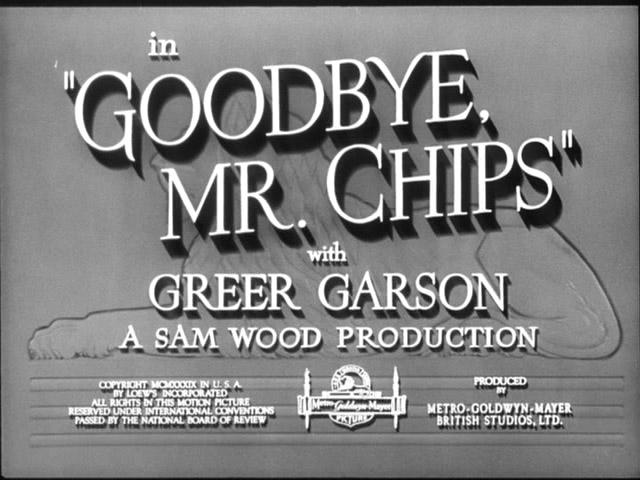
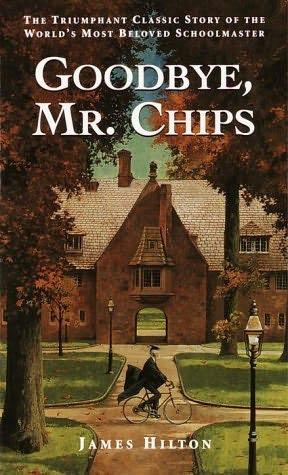
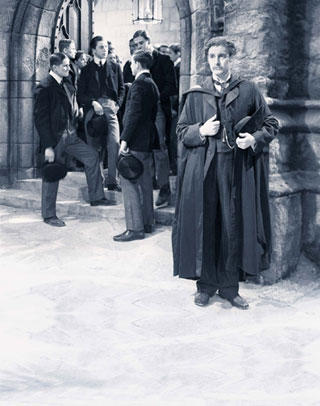
Goodbye, Mr. Chips (1939)

Nora's Nite
Pasta with tomatos & pine nuts, Ice cream, Apple Tortes
"James Hilton later said it took only four days to write Goodbye, Mr. Chips.

He had promised a short story to a British magazine -- but hadn't a notion what to write about. So he went off on a bicycle tour and the idea for a tale about a schoolmaster came to him as he wheeled through Epping Forest.

After four days at the typewriter Hilton had over seventeen thousand words, far too much for a short story, but his editors knew they had something special and published it anyhow as a special supplement in their magazine. Has any writer ever had a more profitable four days work?" LINK

Author James Hilton
"While best known for creating Mr. Chips, the quintessential English schoolteacher, James Hilton was less a Lancashire lad than a Hollywood insider. After early success as a novelist, he made his mark during the golden age of the movies, penning scripts for Frank Capra and Greer Garson and collaborating with Frances Marion, the most successful female screenwriter of her day.

In 1935, after the success of Goodbye Mr. Chips, Hilton was invited to Hollywood to work as a screenwriter. Before leaving, he married his live-in girlfriend, Alice Brown, a secretary at the BBC. As Hilton was by now becoming a public figure, they traveled to Eastbourne to avoid any scandal over their previous illicit living arrangement. The American press awaited their arrival in New York, where husband and wife gave interviews before continuing on to Los Angeles, where again they were given a tremendous reception. The glittering Hollywood lifestyle would prove disastrous for Hilton's marriage, which ended in divorce in 1937. Only seven days later he married Galina Kopineck, a young starlet (who he would also divorce eight years later).

While Hollywood undid Hilton's personal life, his career thrived there. He won the Best Screenplay Oscar for Mrs. Miniver (1942); actress Greer Garson also earned a Best Actress Oscar in the title role. Directed by William Wyler, the film depicts a middle-class English family's life during first months of World War II. Hilton also wrote screenplays for Camille (1936), Foreign Correspondent (1940), Forever and a Day (1943), The Story of Dr. Wassell (1943), The Tuttles of Tahiti (1942) and We Are Not Alone (1939). Other screenwriters adapted his novels Knight Without Armour (1937), Lost Horizon (1937), Rage in Heaven (1941), and Random Harvest (1942). Robert Donat won a Best Actor Oscar for the title role in Goodbye Mr. Chips (1939), but Hilton could not entirely take credit for the success of this film; Eric Maschwitz, C. Sherriff, and Claudine West had adapted his novel for the screen." LINK
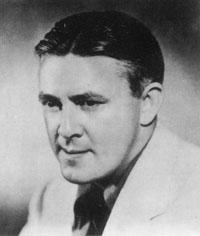
Director Sam Wood
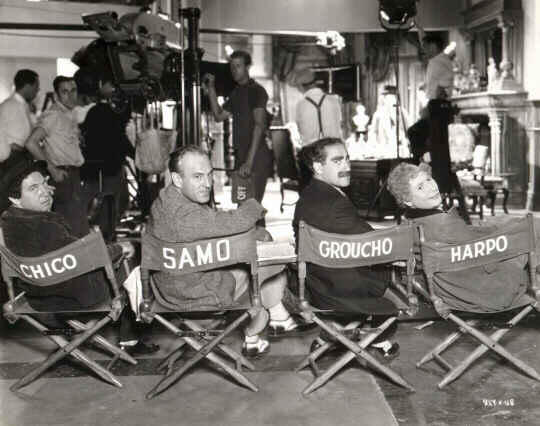
"When American director Sam Wood first reported to Cecil B. De Mille as an assistant in 1915, Wood had already dabbled in real estate and acted on-stage under the name of Chad Applegate. A solo director by 1919, Wood worked throughout the '20s directing some of Paramount's biggest stars, among them Gloria Swanson and Wallace Reid. He began his long association with MGM in 1927, working with personalities as varied as Marion Davies, Clark Gable, Marie Dressler, and Jimmy Durante. He guided the Marx Brothers through their two most profitable films, A Night at the Opera (1935) and A Day at the Races (1937), and turned out one of the most accomplished sentimental dramas ever made in Hollywood, Goodbye, Mr. Chips (1939).

Hopping from studio to studio in the '40s, Wood directed Ginger Rogers through her Oscar-winning performance in Kitty Foyle (1940), successfully transferred Thornton Wilder's highly theatrical Our Town (1940) to the screen (even the studio-imposed happy ending worked), and assembled the quintessential baseball biopic, The Pride of the Yankees (1942).

The list of Wood's successes would seem to assure him a niche in the ranks of all-time best Hollywood directors, yet his reputation has tarnished since his death in 1949. Most detractors insist that Wood was a hack, citing his habit of shooting each scene an average of 20 times, his only verbal direction in each instance being "Go out there and sell 'em a load of clams."

In truth, this technique was invaluable in wearing down such mannered performers as Walter Brennan, Dan Duryea, Frank Morgan, and Wallace Beery, until they were tired enough to behave like human beings instead of play-actors. The 20-take habit also enabled the more limited actors to re-think their interpretations until they'd found nuances that they would never have considered on the first take: Ronald Reagan, who was certainly no Olivier, was never better than in Wood's Kings Row (1942).

Taking into consideration all the complaints about Sam Wood, the biggest bone of contention seems to be his reactionary politics. Wood was active in a number of right-wing organizations, and in 1947 he virulently condemned Hollywood's "left" before the House Un-American Activities Committee. Those whose politics are diametrically opposite to Wood's dwell incessantly upon this aspect of his life, embellishing the facts by painting him as a bigot and (in the words of Groucho Marx) a "fascist." But just as it is fitting and proper to separate the performances of a Jane Fonda, Shirley MacLaine, or Paul Newman from their political agendas, so too would it be fair to extend the same courtesy to Wood. No matter what sort of man Sam Wood was personally, his string of Hollywood hits should be his true legacy." LINK

Tuesday, May 17, 2005

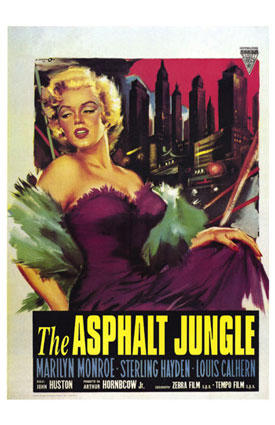
The Asphalt Jungle (1950)

Peter's Nite
Salad, Pizza, Ice Cream
"John Huston was the son of famed actor Walter Huston, born August 5, 1906, in Missouri. While he tried his hand at some acting and writing early on, mostly through his father's contacts, he didn't really begin to devote himself to films until 1938, when he began writing or contributing to scripts for various films. In 1941, he convinced Warner Bros. to let him direct a third version of Dashiell Hammett's detective story, and made the most of the opportunity. After WWII, he won his first and only pair of Oscars, for directing and writing The Treasure of the Sierra Madre (1949), also starring Humphrey Bogart. The collaboration between Huston and Bogart was legendary; in fact, of the five films generally considered Huston's best, only The Man Who Would Be King (1975) doesn't include Humphrey Bogart in its cast."
Mobile Marilyn
"Now you can accessorize your mobile phone with all of the glamour, glitz and fun that is Marilyn. Be the first to enjoy this extensive collection of phone gems created from digitally re-mastered versions of your favorite Marilyn Monroe films including Gentlemen Prefer Blondes, How To Marry A Millionaire, Bus Stop, The Seven Year Itch and many more. Great movie scene moments, best loved lines, authentic poster art and new expressions of her famous wit can now flatter your phone as wallpapers, ringtones and video clips. You can even send a custom Marilyn picture or audio message to your friends and her fans."