Sunday, March 11, 2007

49th Parallel (1941)


Stuart's Nite
Screenonline:
For their third collaboration, Michael Powell and Emeric Pressburger were engaged by the Ministry of Information to make a propaganda film. 49th Parallel (1941; The Invaders in the US), was a concerted attempt to influence opinion in neutral America into supporting their government's entry into the war.

Pressburger proved an enthusiastic propagandist. As he later said, "Goebbels considered himself an expert on propaganda, but I thought I'd show him a thing or two." This is despite the fact that Pressburger's own status in Britain at the time was as an 'enemy alien'. On returning from Canada he found himself imprisoned and threatened with deportation, until Powell and the MOI intervened.

Pressburger's script, which won him an Academy Award for Best Original Story, charts the progress of a German U-boat crew stranded in Canada after the sinking of their craft off Hudson Bay. As the six crew members, led by the unflappable Corporal Hirth (Eric Portman), struggle to reach the neutral territory of the United States, they encounter a series of opponents, who serve to contrast Canada's democracy and ethnic diversity with the Nazis' moral bankruptcy.

The ruthless Hirth is a far cry from the more sympathetically portrayed German officer played by Conrad Veidt in Powell and Pressburger's earlier Spy in Black (1939). Unburdened by doubts in himself or in his philosophy, he has no patience with weakness or sensitivity. But his arrogance is his undoing, for he repeatedly underestimates his opponents. The other Nazis each have their own distinct characters, and there is even a 'good Nazi', which attracted some criticism at the time.


German actress Elisabeth Bergner, the only woman in a leading role, jumped ship after shooting a few scenes in Canada; it became clear she had only signed on to get to America. Fortunately, she was very effectively replaced by the unknown Glynis Johns. Two other stars, Laurence Olivier and Raymond Massey, almost pulled out, and the MOI threatened to pull the plug due to budget overspend. When Hollywood giants David O. Selznick and Samuel Goldwyn showed an interest, however, J. Arthur Rank stepped in and provided the rest of the money. He - and the Treasury - made their money back comfortably: a success at home, the film became the biggest British hit to date in American cinemas.

49th Parallel was the first of two collaborations between Powell and Pressburger and the already highly regarded editor David Lean.

Sunday, March 04, 2007

The Servant (1963)

Peter's Nite
Caroline Millar via Screenonline:
The opening sequence of stark, leafless trees outlined against a cold English sky suggests the clinical austerity of 1960s Britain and hints at the cold manipulations that follow. The first shot of Barrett, leaving Thomas Crapper Sanitary Engineers (presumably his previous workplace), slyly insinuates the theme of the film as the 'flushing away' of the old order. His clipped appearance and punctuality tells us he means business, while the first shot of Tony (a 'businessman') finds him vulnerable, asleep in a chair.

The drama revolves around issues of both class and gender, and the relationship between the two. While Barrett slowly insinuates himself in the house and manipulates his master by slyly rearranging the decor, it is through sex (in the shape of his alluring and sexually permissive 'sister', Vera (Sarah Miles)) that he finally brings about Tony's downfall. The calculating allure of Vera, in contrast to the stuffy, over-bred Susan (Wendy Craig), cuts through the class barriers and brings Tony down to the same level as his servant. Soon the boundaries between master and servant break down, as Tony succumbs to the will of his stronger adversary.

Belonging to an era of filmmaking which for the first time dealt explicitly with issues never before seen on screen, The Servant (in common with many of the contemporary British New Wave) is also artistically ambitious. Several scenes (particularly those between Tony, Barrett and Susan) are seen through the distortion of the big, round, convex mirror which sits on the living room wall, reflecting the unnatural, misformed relationships between the people in the room. Each shot is directed with precision, often framing Susan or Vera between Tony and Barrett, or positioning one of the two men close to the camera while his rival lingers in the background.


Tom Sutpen via brightlights:
Although Pinter was a contemporary of John Osborne and Arnold Wesker — and was often cited as an essential figure in the “Angry Young Man” school of British theater those men had largely forged — his work resembled theirs only superficially. While Osborne’s plays, for example, couldn’t have been more direct about their social concerns, Pinter’s were obscure to the point of abstraction. If he was “angry” about anything, it was impossible to determine what he was angry about. His work was simply never concerned with the larger issues of society, and the only politics he routinely confronted were those in the language of human interaction, He was endlessly preoccupied with the treacheries inherent in the most time-worn relations. In fact, it was the only theme he returned to again and again: the subtle determination of some to undermine and destroy one another while maintaining a façade of order and civility. In this respect, his screenplay for The Servant is one of his greatest works, the equal of anything he wrote for the stage. With his devastating economy of dialogue and explication, he unblinkingly chronicles the savage destruction of one man’s will at the hands of another; not the half-bright social parable of some critics’ dreams. This, and not a barely existent subtext, is what makes The Servant such a disturbing film.


Viewers and critics who sought to drown The Servant in sociopolitical syrup were avoiding the obvious. There is something indeed tragic about the decline of this upper-class twit that failed to register with more class-conscious critics. In the final sequence, when Susan sees for herself the sodden, hopeless laudanum freak Tony has become, and flees from what she suddenly realizes was always Barrett’s house, she clings to a tree and weeps uncontrollably. And along with her, we can’t help but feel that, despite Tony’s basic lack of character, something has been irretrievably lost. But anyone who imagined that some fundamental reversal had taken place between Barrett and Tony at the end needed glasses. Barrett is no more the “working-class hero” of The Servant than Tony is. Though Barrett has laid waste to Tony’s will more thoroughly than if he'd murdered him, he’s still the man’s servant. He continues to cook the meals, fix the drinks, answer the doorbell, lock up at night. He has attained an enduring power over Tony, and can now indulge himself with the impunity of a Tiberius. But it is a limited power. A power achieved only by performing his duties, by pleasing his employer.

Monday, January 22, 2007

Hud (1963)


Pamela's Nite
Salad, Awesome HOMEMADE PASTA! Fantastic brownies, Spectacular lemon bars.
Nora's interest in doors continues strong.
"Low Key Legend" Seattle International Film Festival tribute to James Wong Howe:

Born Wong Tung Jim in Canton, China, Howe immigrated to America with his family when he was five, to Pasco, Washington to be exact. As a teenager he ventured south to Los Angeles with dreams of becoming a professional boxer. He turned instead, in 1917, to a career in motion pictures, and was first-cameraman within a few years.
He was an artist, and an incomparable one, but he brooked no self-display, no phony self-consciousness. Although sufficiently enamored of low-key lighting to earn the industry nickname "Low Key Howe," he believed that the camerawork should serve the reality of the imaginative situation called up by the story. He strove to avoid "movie lighting," and hated having to deploy shadows all over the place in The Thin Man. Director Woody Van Dyke thought that the more shadows, the more the audience would recognize it was a mystery movie. Howe thought that the more shadows, the more you knew the setup was artificial, a movie scene, not a real room with a logical, dominant light source--or a canyon wall lit only by the sun. (But he gave great shadow in The Thin Man. It was his job.)
He could shoot anything and get it right. He played around with zoom lenses thirty years before the rest of Hollywood became aware of them. Once, back in the pre-panchromatic silents, Howe figured out that a certain vacant-eyed actress would register better on film if he draped a black cloth behind his camera; the black reflected on the retinas of her pale gray eyes – and made her career, and his. You never knew what would work. Getting set to shoot a scene in a Western clearing (in Martin Ritt's Rashomon adaptation, The Outrage), he saw that some rocks were going to throw off sun glare and distract from the actors. Howe pulled out a handy spray can of black paint (always kept a can of black paint in his box), and the rocks didn't glare anymore.
Howe's granddaughter remembers via MovieMaker Magazine:

For young Wong Tung Jim, those early years in America were not happy ones. He was a constant subject of ridicule because of his Chinese heritage. Jimmie would take candy from his father's store to bribe the neighborhood children into playing with him. Prejudice would follow him throughout his life and career; although, ironically, his ethnicity distinguished him from other cinematographers and played a role in making him one of the best-known practitioners of his craft in the world.

James Wong Howe was around 12 years old when he bought a little Brownie camera in a drugstore. He took pictures of his brothers and sisters, even though his father was an old-fashioned Chinese who was superstitious about having his photo taken. When he had the film developed, their heads were missing! This wasn't because of some angry spirit lurking nearby, but due to the fact that his camera had no viewfinder. Just the same, Jimmie's father was very displeased with the results, to say the least.

Several years passed, and Jimmie left for Oregon to take up boxing. This had no lasting appeal for him. Eventually he became a delivery boy for a commercial photographer in Los Angeles, but was dismissed when he helped a friend who was going back to China by doing some passport photos in the firm's laboratory.

Jimmie next took a job as a busboy at the Beverly Hills Hotel. On Sundays he would go to Chinatown to watch a comedy being shot. He spoke to the cameraman, who suggested to Jimmie that he try working in the movies. Shortly thereafter, Jimmie went to the Jesse Lasky Studios, but the man in charge of photography told him that he was too small and frail to carry the equipment. Instead he hired Jimmie to pick up scraps of nitrate stock from the cutting-room floor for 10 dollars a week. In his spare moments, he became familiar with the hand-cranked cameras, the lighting equipment and the film-laboratory processes.
Jimmie's break came in 1919 on the Cecile B. DeMille film Male and Female. The crew was shooting a scene in which Gloria Swanson was to be attacked by a toothless lion. The sequence required multiple cameras, and there were not enough assistants. Jimmie was called from the camera room and given the slate. He was dubbed the fourth assistant cameraman. Before long, Jimmie endeared himself to DeMille. The legendary director had encountered a major production problem: he needed a close-up of a canary singing, and the crew tried everything to get the bird to sing, but to no avail. Jimmie asked if he could try. He took a piece of chewing gum and lodged it in the canary's beak. The bird moved its beak in an attempt to dislodge the gum, and on silent film it looked like it was singing. DeMille was impressed and raised Jimmie's salary to 15 dollars a week.

Sunday, January 14, 2007

The Fallen Idol (1948)


Peter's Nite
Beef, green beans a la Nora, Home baked cookies
Deirdre Feehan on Carol Reed via Senses of Cinema:
Born December 30, 1906 in London, British director Sir Carol Reed was the second son of the actor Sir Herbert Beerbohm Tree and his mistress May Pinney. Following a public school education, Reed made his theatrical debut in 1924. He joined Edgar Wallace's troupe and acted in several plays, later overseeing film adaptations of Wallace's plays by Basil Dean's Associated Talking Pictures. (1) Between 1932 and 1934, Reed worked for Associated Talking Pictures, first as a dialogue director, then later as a second-unit director and an assistant director. (2) With Robert Wyler, he co-directed It Happened in Paris (1935), a comedy based on a French play. Reed's directorial debut came with Midshipman Easy (1935), a historical romance that marked his first foray into novel-to-film adaptations.

He began his directing career as the British film industry blossomed under producers Sir Alexander Korda, Basil Dean, J. Arthur Rank and Edward Black. Reed's first successes, Midshipman Easy (1935) and Laburnum Grove (1936), were produced by Basil Dean and scripted by Anthony Kimmins from popular novels, respectively, Marryat's Mr. Midshipman Easy and J.P. Priestley's Laburnum Grove. Reed collaborated with Anthony Kimmins on the story and the screenplay for Talk of the Devil (1937). Kimmins scripted four of Reed's first five films, bringing his own directing expertise to Reed's productions.

Collaboration marks Reed's most successful films as he himself claimed. (3) He worked not only with the same writers (Kimmins, Eric Ambler, Graham Greene) but often with the same art directors (Victor Korda, Vetchinsky), cinematographer (Robert Krasker) and editor (R.E. Dearing). Reed served as his own producer during the 1940s and 1950s, only relinquishing control after the flop, The Agony and the Ecstasy, in 1965.
Screenonline on Carol Reed:

Carol Reed was born in Putney, south London, on 30 December 1906, one of six children of the actor-manager Sir Herbert Beerbohm Tree and his mistress, Beatrice Mae Pinney. Tree, who was respectably married, supported his second household substantially. Reed grew up in solid middle-class comfort, and was sent to a traditional public school, King's School, Canterbury, which he loathed. He planned to follow his father and become an actor, but in 1922 his mother, hoping to deflect this ambition, sent him to Massachusetts to join his elder brother on a chicken farm. Having neither taste nor aptitude for farming, Reed was back in England within six months. His mother gave way, and he joined a company headed by Dame Sybil Thorndike, making his stage debut in 1924.

Edgar Wallace, the alarmingly prolific thriller writer, had formed a troupe to put on stage adaptations of his novels. Reed joined him and appeared in three Wallace productions, doubling as assistant stage manager. When Wallace accepted the chairmanship of the newly formed British Lion Film Corporation in 1927, Reed became his personal assistant, helping to supervise filmed adaptations of Wallace's thrillers during the day while still acting and stage managing in the evenings. This hectic double life continued until Wallace died of pneumonia in 1932. Abandoning the stage for good, Reed moved to Ealing Studios as dialogue director for Associated Talking Pictures, then being run by Basil Dean.

At Ealing Reed swiftly worked his way up from dialogue director to assistant director. His first experience of directing was on It Happened in Paris (1935), a comedy directed by Robert Wyler (William Wyler's elder brother) to which Reed contributed additional footage. The following year he directed his first solo film, Midshipman Easy, adapted from Captain Marryat's Victorian adventure novel. Graham Greene, writing in The Spectator, felt that Reed showed "more sense of the cinema than most veteran British directors". Greene was even more taken by Reed's next film, Laburnum Grove (1936), adapted from a stage comedy by J.B. Priestley. "Here at last is an English film one can unreservedly praise," he wrote with an almost audible sigh of relief; both films, he went on, were "thoroughly workmanlike and unpretentious, with just the hint of a personal manner which makes one believe that Mr Reed, when he gets the right script, will prove far more than efficient".
BFI on The Fallen Idol:

This is the great London film of a director celebrated for his atmospheric evocation of cities such as Belfast, Berlin, and Vienna – urban labyrinths in which secrets lurk around every corner. Shot by the great French cinematographer Georges Périnal, it vividly captures the city's sunlit squares and shadowy night-time streets, as well as the cold, cavernous interiors of the embassy residence.

The critics of the time, wearied by "a flood of second rate sagas", greeted The Fallen Idol with relief, bestowing particular praise on the amazingly natural performance of Bobby Henrey (acclaimed by The Sunday Chronicle as "the greatest Kid since Coogan") and Richardson’s beautifully understated interpretation of his role. Looking back today, the film is also notable for a wickedly funny cameo from Dora Bryan (in just her second film appearance) as the tart with a heart who encounters the runaway Felipe in a police station.

Graham Greene's script, adapted from his novella 'The Basement Room' (1935) about a young boy who unwittingly betrays his friend to the police, was to win him an Oscar nomination as well as the award for Best Screenplay at Venice. Preferred by Greene to The Third Man (his next collaboration with Reed), The Fallen Idol is a work of exceptional psychological subtlety and an acute portrayal of the separate realities inhabited by adults and children, with their conflicting interpretations of the world around them.
DVD Savant goes behind the scenes:

If the stories of the filming of The Fallen Idol are to believed, the actors working with young Bobby Henrey are to be commended, for director Reed had to coax and tease a performance out of a boy simply unsuited for acting work. Henrey had the perfect look and manner -- the typical trained English child actor would have been useless -- but he also had a short attention span, became bored easily and wouldn't follow directions. According to assistant director Guy Hamilton, Bobby would burn up thousands of feet of film looking in the wrong direction or departing from character. Much of Henrey's performance is pasted together from bits of takes brilliantly edited to create a wonderful natural portrait of a charming child. Reed must have had an enormous respect for children to maintain the patience needed to get the film he needed.
New York Times encounters Graham Greene:

''A major character has to come somehow out of the unconscious,'' the writer told a questioner in a rare and vivid appearance beyond the pages of his books. He told of cataloguing his dreams, searching for the tracks of a fresh character in fiction. ''Because I was psychoanalyzed when I was 16,'' he said, ''I have always been interested in dreams and the unconscious.'

A select audience of his readers were rapt in inquiring about evil and boredom, God and Communism and the ways of Mr. Greene's mind as he spoke in a private session at Georgetown University Monday night. ''The moment comes when a character does or says something you hadn't thought about,'' he told another questioner, and Mr. Greene's gratitude and longing for this serendipitous trick seemed palpable in the dimness of Gaston Hall. ''At that moment he's alive and you leave it to him.''

Yes, but how do you do it? The questions in the hourlong visit were variations of this basic inquiry into the labors of imagination.

''I generally have a character and the beginning of a story,'' Mr. Greene said, ''and the end of a story.'' A pause, a thin smile from the angular, white-haired man seated onstage in a blue suit worthy of his wartime days as an intelligence agent. ''And in between,'' he continued, ''the middle develops in a way I don't foresee.'' Yes, but how do you do it? ''When I was young, I wrote a book in nine months, like a childbirth,'' he said, looking back from his 82d year. With time, the process lengthened for him to three years, then 10 years, he said, sounding autumnal. ''Now there are long intervals before the idea for a new book comes. That's a very painful period.''

Part of his charm for the audience clearly was that sharp fragments of Graham Greene's reality reappear burnished in his fiction, most graphically in his movie scripts for ''The Third Man'' and ''Our Man in Havana.'' After all his talk of dreams and flight from boredom, he sounded like a proud laborer in describing how anger had worked just as well to settle esthetic struggles with Carol Reed, the movie director.

''The fighting would begin and I'd say, 'Oh for God's sake let's abandon the bloody thing,' and after that everything would go smoothly,'' Mr. Greene told his listeners, who departed after thankful applause, still wondering how he does it.

Sunday, December 17, 2006

Pat Garrett & Billy the Kid (1973)

Stuart's Nite
La-La's Salads, Cheesecake, Cookie Selection
Tom Block on Pat Garrett & Bill the Kid via Highhat:

Despite a highly talkative (and rustically profane) script by Rudolph Wurlitzer, it’s a nearly plotless movie that — at its best — communicates its points indirectly, in shadowy bits of irony that constantly redouble on each other. It’s a film almost baroque in its unevenness, with the warring blood between Peckinpah and Wurlitzer, his producers and himself leading to sundry lapses of judgment and care: a main character who’s more Rorschach test than flesh and blood; a woozy, anxious turn by an untrained leading actor; pages of overripe dialogue; downright toxic performances from a cadre of supporting players; and a Bob Dylan score that often works against the grain of what’s happening up on the screen. To cap it all off Pat Garrett & Billy the Kid was never authoritatively “finished,” with the optimal available version — the so-called “director’s cut” — still falling miserably short of a fine cut and missing a key scene to boot. As problematic Westerns go, it makes The Searchers look like a cakewalk.

Rudolph Wurlitzer built his screenplay around the happily elastic fact that Pat Garrett and Billy the Kid knew each other in some capacity before Garrett became a lawman,* but it would take a major assist from Peckinpah for a story whose foregone conclusion is its very point to take on dramatic shape, and thus solve a problem that’s led so many directors of Christ-figure epics around by the nose.

The Stations of the Cross here are splayed out across a lunar New Mexican landscape, and consist of vignettes, most of them formed as parables or mood-poems, that often end in an act of violence that redirects the principals in some way, with each reorientation bringing the two men that much closer to their final meeting. If not for its bloodletting the movie might play more like opera bouffe than existential drama: Garrett spends his time resolutely avoiding Billy’s hideout, choosing instead to share a few words with seemingly every man, woman and child in Lincoln County before he’s finally moved to finish the job. In Pat Garrett’s world character is often revealed through inaction, leading to a movie about, in producer Gordon Carroll’s unbeatable description, “a man who doesn’t want to run … being pursued by a man who doesn’t want to catch him.”

Wurlitzer had sold the screenplay on the strength of his script for Two-Lane Blacktop, another existential scarecrow, but while his new Western was much admired, its two main characters didn’t come together until the climax. Recognizing that a more clearly defined conflict was needed, Peckinpah added the scene at the beginning in which Garrett visits the Kid at Fort Sumner and gives him five days to leave the territory. It’s a beautifully modulated exchange, rife with the undercurrents of a nettled friendship, as Garrett — mindful of the ear-shot proximity of Billy’s gang — tersely delivers his message to Billy, who, tenderly, and at times almost pathetically, tosses up reminders of their shared past.
Peckinpah also added the movie’s most inspired stroke, the stark black-and-white prologue set some 30 years in the future that shows Garrett being bushwhacked for reasons rooted in his dealings with the Kid. The sequence, completed in the editing room, is a marvel of implication, as first Billy and his gang, and then Garrett himself, are seen in 1881 firing a fusillade of bullets into the Garrett of 1909, bringing home how tightly woven the deterministic web is that binds the two men. The sequence’s visceral power comes from the interplay between the gang’s unwittingly callous by-play — “Damn near perfect” one of them opines as a slug tears out yet another chunk of the old man’s body — with the off-kilter angles and oddly-timed freeze-frames depriving Garrett of any of the majesty that graced Joel McCrea in his descent to the bottom of the frame in Ride the High Country. This brutal opening, one of Peckinpah’s finest set pieces outside of The Wild Bunch, puts its audience on instant notice that nothing pretty is coming its way.
Bob Dylan "Knockin' on Heaven's Door" (Special McGari- Mix)

For more on 'Bloody Sam' see our MovieNite screening of Ride the High Country (1962).

Sunday, December 10, 2006

Moulin Rouge (1952)


Pamela's nite
Thai take-out
Oswald Morris papers via University of Exeter:

Oswald (‘Ossie’) Morris (1915- ), cinematographer, OBE, BSC, was born on 22 November in Middlesex. One of the most significant cameramen of the post-war era, Ossie began his career working as a projectionist during his school holidays. In 1932, he left school to become an apprentice in the film industry, with his first job as a clapperboy on After Dark (1932) at Associated Sound Film Industries, Wembley. During WWII, Morris served as a bomber pilot for the Royal Air Force, and returned to the film industry when the war ended. After some experience as an operator at Pinewood in 1946, he was given his first film to light in 1950.

His career took off properly in 1952 when he was asked to take over the photography of the film Moulin Rouge, which was to become a milestone in Technicolour photography. He continued to develop new trends in colour cinematography in Moby Dick (1956). He was also equally at home in black and white, working with Vittorio De Sica on Selznick’s Stazione Termini (1953). His first feature film as photographer was Look Back in Anger (1959), with well-known classics such as The Guns of Navarone (1961), Lolita (1961), The Hill (1965), Oliver! (1968) (nominated for an Oscar in 1968) and Goodbye Mr Chips (1969) following in quick succession. Pumpkin Eater (1964) won a BAFTA for Best Black and White Cinematography in 1964. He then won an Oscar in 1971 for Fiddler on the Roof (1971), which was shot through a brown silk stocking in order to portray the colours of the Yugoslavian landscape on screen. Other 1970s films include Sleuth (1972), The Man with the Golden Gun (1974), The Man who would be King (1975) and The Wiz (1978) (nominated for an Oscar in 1978), a re-make of The Wizard of Oz. Prior to his retirement in 1982, Morris photographed The Great Muppet Caper (1981) and The Dark Crystal (1982) with Jim Henson. In 1997 he was awarded an OBE, and was a Recipient of a Fenton Medal, Royal Photographic Society in 2001.


Physically unable to participate in most of the activities typically enjoyed by men his age, Toulouse-Lautrec immersed himself in his art. He became an important post-Impressionist painter, art nouveau illustrator, and lithographer and recorded in his works many details of the late-19th century bohemian lifestyle in Paris. Toulouse-Lautrec also contributed a number of illustrations to the magazine Le Rire during the mid-1890s.

He was declared to be "the soul of Montmartre", the Parisian quarter where he made his home. His paintings portray life at the Moulin Rouge and other Montmartre and Parisian cabaret and theaters, and in the brothels that he frequented (and where he perhaps contracted syphilis). Two of the well-known people he portrayed were singer Yvette Guilbert, and Louise Weber, known as the outrageous La Goulue, a dancer who created the "French Can-Can."

Toulouse-Lautrec gave painting lessons to Suzanne Valadon, one of his models (and, by all accounts, probably his mistress as well, from whom he is believed to have contracted syphilis).

An alcoholic for most of his adult life, he was placed in a sanatorium shortly before his death. He died from complications due to alcoholism and syphilis just before his 37th birthday, at the family estate in Malromé; he is buried in Verdelais, Gironde, a few kilometres from his birthplace. His last words were reportedly "Vieil imbécile!" ("Old fool"), in reference to his father, who was present at the scene.

After his death, his mother, the Comtesse Adèle Toulouse-Lautrec, and Maurice Joyant, his art dealer, promoted his art. His mother contributed funds for a museum to be built in Albi, his birthplace, to house his works. As of 2005, his paintings had sold for as much as $14.5 million.

Sunday, December 03, 2006

The Bank Dick (1940)

Peter's Nite
Dennis Perrin via Criterion:

The Bank Dick, written by Fields under the nom de plume Mahatma Kane Jeeves, contains many of the same themes found in his short films: the hectoring family, small-town puritanism, irritating children, the love of drink and smoke. (There is also the now-troubling ethnic stereotype, here in the guise of the Shufflin’ Hollywood Negro who, in his desire to draw money from his account, practically scares Fields to death.) These themes served Fields well, not only in this film, but in most of his better work. And what makes the comedy unique, especially for its time, is that Fields grants no one moral high ground. Everyone has an agenda, is on the take, is insipid or simply meddlesome; the worst character traits usually belong to Fields himself. Although this style of comedy is sometimes tried today (the best recent example was Seinfeld, part brainchild of Larry David, a truly dark absurdist who never met a protaganist he seemed to like), rarely is it done with the subtle malice of which Fields was a master.

So enjoy The Bank Dick, and don’t be fooled by the clumsy behavior of its star. Advanced in years and near the end of his career (after Never Give a Sucker an Even Break in 1941, he popped up in a few cameo roles before his death in 1946), Fields was in full command of his powers. Like Fatty Arbuckle before him, and Jackie Gleason and John Belushi after him, Fields put his pudgy frame to fine comedic use. The result? Drunk, awkward, indifferent to the needs of others, Egbert Sousé prevails and remains true to his one love, The Black Pussy. A morality tale as only W.C. Fields could, and did, conceive.

W.C. Fields Juggles

W.C. Fields, Juggler via Juggler.org:

The juggle bug seems to have bitten William Claude Dukenfield at the age of 14, after he saw a performance of the juggling Burns Brothers. The bug must have bit hard, for it inspired this young man to become one of vaudeville's most successful entertainers, W.C. Fields, 'The Eccentric Tramp Juggler.'

W.C. Fields the juggler bears little resemblance to W.C. Fields of later movie and radio fame. The young, trim, and handsome juggler presented a silent act, hiding behind a bizarre tramp face. The W.C. Fields drawl and clever wit were confined to off-stage appearances, as he did not add any talking to his act until about 1915. This worked to his advantage while touring Europe, as he was not confronted with a language barrier. He also felt that he wanted the audience to concentrate on his juggling skills, and that talking would be distracting. Even though juggling was popular at the time, it had to be different to be memorable. Fields made his juggling memorable chiefly through the of comedy.

His show business career got a real start when he joined a tour with the Keith Vaudeville Circuit at age 19. Besides his juggling act, he had to shift scenery, play in a musical comedy and perform other odd jobs. Eighteen months on this circuit led Fields to New York City, where he received great reviews and a job with the Orpheum Circuit (which lasted four years) at $125 per week.

About this time he married Harriet Hughes (and began a wrangle which continued until his death), who joined his act as assistant and straight woman. The act consisted of about 20 minutes of comedy juggling.

Fields entered a stage almost barren of props. He wore old, torn, loose clothing (saving wardrobe expenses) with his face made up to look unshaven. His few props were tennis balls (he could juggle six), a balancing stick, a top hat, and cigar boxes (available for free).

He developed a genius for the conscious error, the retrieved blunder. A review of his act in the San Francisco Examiner summed it up with, "It is impossible to tell whether Fields makes real or fake mistakes in his juggling. He will drop a hat apparently by accident in the middle of some difficult feat and then catch it by another apparently accidental movement. It is all so smooth and effortless."
New York Times biography:

A Charles Dickens character come to life, American comedian W. C. Fields (born William Claude Dukenfield) ran away from home at age 11. Continuous exposure to cold weather gave his voice its distinctive hoarse timbre, while constant fights with bigger kids gave Fields his trademarked red, battered nose. Perfecting his skills as a juggler until his fingers bled, Fields became a vaudeville headliner before the age of 21, traveling the world with his pantomimed comedy juggling act. After making his Broadway debut in the musical comedy The Ham Tree (1906), "W.C. Fields -- Tramp Juggler," as he then billed himself, achieved the pinnacle of stage stardom by signing on with impresario Flo Ziegfeld. Somewhere along the line the comedian decided to speak on stage, to the everlasting gratitude of Fields fans everywhere. Though his flowery, pompous comic dialogue would seem to have been indispensable, Fields did rather well in silent films (the first was the 1915 one-reeler Pool Sharks) thanks to his keen juggler's dexterity. In 1923, Fields took Broadway by storm with a part specially written for him in the musical Poppy. As larcenous snake-oil peddler Eustace McGargle, the comedian cemented his familiar stage and screen persona as Confidence Man Supreme. Poppy was filmed as Sally of the Sawdust by director D.W. Griffith in 1925; incredible as it may seem, Fields was not the first choice for the film, but once ensconced in celluloid (to use a Fields-like turn of phrase), he became a favorite of small-town and rural movie fans -- even though it was those very fans who were often the targets of Field's brand of social satire.

From 1930 through 1934, Fields appeared in talking feature films and short subjects, truly hitting his stride in It's a Gift (1934), which contained his famous "sleeping on the back porch" stage sketch. By this time, audiences responded to his characterization of the bemused, beleaguered everyman, attacked from all sides by nagging wives, bratty children, noisy neighbors and pesky strangers. His film characters also embraced his offstage adoration of alcoholic beverages (Fields was one of the more conspicuous and prolific drinkers of his time). In private life, Fields was perhaps Hollywood's most enigmatic personality. He was simultaneously an inveterate ad-libber and improviser who meticulously prepared his ad-libs and improvisations on paper ahead of time; a frequently nasty, obstinate man who was surrounded by a strong core of loyal and lasting friends. Beloved by most of his fellow actors, W.C. Fields was a man who often showed up late and hung over on the film set, but who never missed a performance and finished all his films on schedule and under budget.

Sunday, November 12, 2006

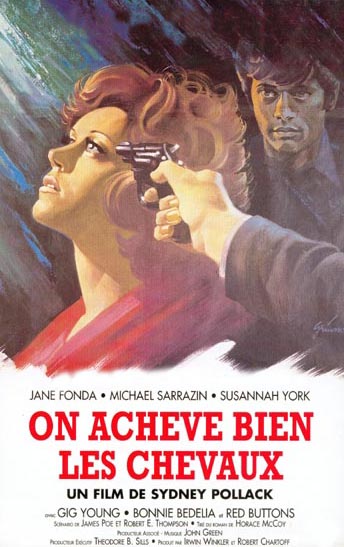
They Shoot Horses, Don't They? (1969)

Pamela's Nite
Nora's Birthday Dinner!
Dance Marathons via Wikipedia:

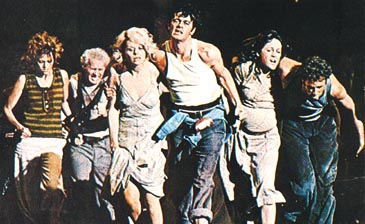
Marathon dancing fit in nicely with the 1920s craze for breaking records and stretching human endurance, with records being set in flagpole sitting, mountaineering, aviation, and more. Dance marathons started similarly, and ended up being one of the most widely attended and controversial forms of live theater.

Contestants and spectators alike bought into the staged excitement and competition. Spectators could cheer, make wagers and root for their favorite team, even interacting with the dancers, chatting with them and throwing money. Contestants were enticed by the potential for fame and fortune, from prizes of several thousand dollars to performing contracts, and were fueled by the audiences’ support and applause. Like professional wrestling, the contests were fixed, but both sides bought into the simulated reality of it and participated heartily, provoking each other and egging each other on. The newest episodic entertainment, spectators would return day after day to follow their heroes and see more drama unfold.

Many contestants, considering themselves theater professionals based on their marathon experience, traveled the country competing in one marathon after another. Especially during the Depression, marathons offered work, shelter, food, and potential for extra money and more. Contestants hoped to have careers in films, and though many took roles as extras, only the few who were veteran performers before entering, like June Havoc and Red Skelton, found real fame and entertainment careers after their marathon days.

Sunday, November 05, 2006

The War Room (1993)

Peter's Nite
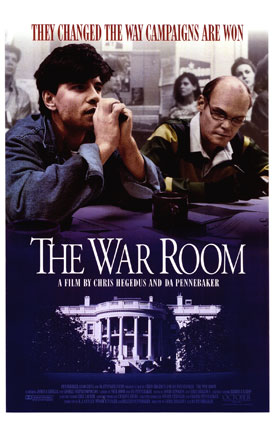
Interview with DA Pennebaker and Chris Hegedus via BBC Four:

BBC Four: The film turned out quite differently from what you originally conceived didn't it?

Chris Hegedus: When we started The War Room, the idea was to watch a man become president. Our intention was to follow the candidates and go through this process with one of them. In the end we weren't granted the type of access necessary to make that sort of story, so we had to look around and ask, "Is there something else we can make here?" And the Clinton campaign was by far the most interesting one going, and then of course we stumbled upon James Carville.

BBC Four: Were you aware of Carville before?

CH: Not at all. He was someone we discovered in the process of making the movie. He was the Head of Strategy for the campaign and we thought, "My god, I can't believe this is the guy who's heading it, but if he is he'll certainly make a good character." And especially with George [Stephanopoulos] being a counterpart, a kind of buddy thing.

BBC Four: It is an odd film to watch with benefit of hindsight.

CH: It is strange, and parts of it are totally undone, like the beginning of the film with Jennifer Flowers. Clinton admitted to having an affair with her. These films that are about historical subjects change incredibly based on subsequent events.

DA Pennebaker: They are so focussed on the moment when they are done that they become like flies caught in amber. Not much that we have of history has that quality because it gets constantly sorted out by historians and people whose business it is to explain what or why it happened. This film doesn't explain anything, it just shows.

BBC Four: US elections get so much TV coverage. How did you think you were doing something different?

DAP: It's interesting. On the day of the election, suddenly ABC, who produced the Six O'Clock News, said they wanted to come into the War Room. And of course they were invited right in. We'd been there for months, and it felt that this was our little province, because no press was supposed to go into the War Room. But what they did was to centre the programme around Ted Koppel, the guy whose show it was. They could have made our film completely, but it didn't fit what they needed to do. It took too long to generate. It would've been a year before any of that stuff could be put out in way that people could go look at it.

BBC Four: Watching it now it seems so full of optimism for the Clinton administration.

DAP: You do see all those hopes and dreams. A year after we finished the film we showed it to everybody down in Washington. They came out of it really shellshocked because even after one year in the White House they were so burnt out. And watching their idealism in that film was very moving to a lot of the staff because it helped them to remember why they're there. It's a record of that spirit.