Sunday, January 14, 2007

The Fallen Idol (1948)


Peter's Nite
Beef, green beans a la Nora, Home baked cookies
Deirdre Feehan on Carol Reed via Senses of Cinema:
Born December 30, 1906 in London, British director Sir Carol Reed was the second son of the actor Sir Herbert Beerbohm Tree and his mistress May Pinney. Following a public school education, Reed made his theatrical debut in 1924. He joined Edgar Wallace's troupe and acted in several plays, later overseeing film adaptations of Wallace's plays by Basil Dean's Associated Talking Pictures. (1) Between 1932 and 1934, Reed worked for Associated Talking Pictures, first as a dialogue director, then later as a second-unit director and an assistant director. (2) With Robert Wyler, he co-directed It Happened in Paris (1935), a comedy based on a French play. Reed's directorial debut came with Midshipman Easy (1935), a historical romance that marked his first foray into novel-to-film adaptations.

He began his directing career as the British film industry blossomed under producers Sir Alexander Korda, Basil Dean, J. Arthur Rank and Edward Black. Reed's first successes, Midshipman Easy (1935) and Laburnum Grove (1936), were produced by Basil Dean and scripted by Anthony Kimmins from popular novels, respectively, Marryat's Mr. Midshipman Easy and J.P. Priestley's Laburnum Grove. Reed collaborated with Anthony Kimmins on the story and the screenplay for Talk of the Devil (1937). Kimmins scripted four of Reed's first five films, bringing his own directing expertise to Reed's productions.

Collaboration marks Reed's most successful films as he himself claimed. (3) He worked not only with the same writers (Kimmins, Eric Ambler, Graham Greene) but often with the same art directors (Victor Korda, Vetchinsky), cinematographer (Robert Krasker) and editor (R.E. Dearing). Reed served as his own producer during the 1940s and 1950s, only relinquishing control after the flop, The Agony and the Ecstasy, in 1965.
Screenonline on Carol Reed:

Carol Reed was born in Putney, south London, on 30 December 1906, one of six children of the actor-manager Sir Herbert Beerbohm Tree and his mistress, Beatrice Mae Pinney. Tree, who was respectably married, supported his second household substantially. Reed grew up in solid middle-class comfort, and was sent to a traditional public school, King's School, Canterbury, which he loathed. He planned to follow his father and become an actor, but in 1922 his mother, hoping to deflect this ambition, sent him to Massachusetts to join his elder brother on a chicken farm. Having neither taste nor aptitude for farming, Reed was back in England within six months. His mother gave way, and he joined a company headed by Dame Sybil Thorndike, making his stage debut in 1924.

Edgar Wallace, the alarmingly prolific thriller writer, had formed a troupe to put on stage adaptations of his novels. Reed joined him and appeared in three Wallace productions, doubling as assistant stage manager. When Wallace accepted the chairmanship of the newly formed British Lion Film Corporation in 1927, Reed became his personal assistant, helping to supervise filmed adaptations of Wallace's thrillers during the day while still acting and stage managing in the evenings. This hectic double life continued until Wallace died of pneumonia in 1932. Abandoning the stage for good, Reed moved to Ealing Studios as dialogue director for Associated Talking Pictures, then being run by Basil Dean.

At Ealing Reed swiftly worked his way up from dialogue director to assistant director. His first experience of directing was on It Happened in Paris (1935), a comedy directed by Robert Wyler (William Wyler's elder brother) to which Reed contributed additional footage. The following year he directed his first solo film, Midshipman Easy, adapted from Captain Marryat's Victorian adventure novel. Graham Greene, writing in The Spectator, felt that Reed showed "more sense of the cinema than most veteran British directors". Greene was even more taken by Reed's next film, Laburnum Grove (1936), adapted from a stage comedy by J.B. Priestley. "Here at last is an English film one can unreservedly praise," he wrote with an almost audible sigh of relief; both films, he went on, were "thoroughly workmanlike and unpretentious, with just the hint of a personal manner which makes one believe that Mr Reed, when he gets the right script, will prove far more than efficient".
BFI on The Fallen Idol:

This is the great London film of a director celebrated for his atmospheric evocation of cities such as Belfast, Berlin, and Vienna – urban labyrinths in which secrets lurk around every corner. Shot by the great French cinematographer Georges Périnal, it vividly captures the city's sunlit squares and shadowy night-time streets, as well as the cold, cavernous interiors of the embassy residence.

The critics of the time, wearied by "a flood of second rate sagas", greeted The Fallen Idol with relief, bestowing particular praise on the amazingly natural performance of Bobby Henrey (acclaimed by The Sunday Chronicle as "the greatest Kid since Coogan") and Richardson’s beautifully understated interpretation of his role. Looking back today, the film is also notable for a wickedly funny cameo from Dora Bryan (in just her second film appearance) as the tart with a heart who encounters the runaway Felipe in a police station.

Graham Greene's script, adapted from his novella 'The Basement Room' (1935) about a young boy who unwittingly betrays his friend to the police, was to win him an Oscar nomination as well as the award for Best Screenplay at Venice. Preferred by Greene to The Third Man (his next collaboration with Reed), The Fallen Idol is a work of exceptional psychological subtlety and an acute portrayal of the separate realities inhabited by adults and children, with their conflicting interpretations of the world around them.
DVD Savant goes behind the scenes:

If the stories of the filming of The Fallen Idol are to believed, the actors working with young Bobby Henrey are to be commended, for director Reed had to coax and tease a performance out of a boy simply unsuited for acting work. Henrey had the perfect look and manner -- the typical trained English child actor would have been useless -- but he also had a short attention span, became bored easily and wouldn't follow directions. According to assistant director Guy Hamilton, Bobby would burn up thousands of feet of film looking in the wrong direction or departing from character. Much of Henrey's performance is pasted together from bits of takes brilliantly edited to create a wonderful natural portrait of a charming child. Reed must have had an enormous respect for children to maintain the patience needed to get the film he needed.
New York Times encounters Graham Greene:

''A major character has to come somehow out of the unconscious,'' the writer told a questioner in a rare and vivid appearance beyond the pages of his books. He told of cataloguing his dreams, searching for the tracks of a fresh character in fiction. ''Because I was psychoanalyzed when I was 16,'' he said, ''I have always been interested in dreams and the unconscious.'

A select audience of his readers were rapt in inquiring about evil and boredom, God and Communism and the ways of Mr. Greene's mind as he spoke in a private session at Georgetown University Monday night. ''The moment comes when a character does or says something you hadn't thought about,'' he told another questioner, and Mr. Greene's gratitude and longing for this serendipitous trick seemed palpable in the dimness of Gaston Hall. ''At that moment he's alive and you leave it to him.''

Yes, but how do you do it? The questions in the hourlong visit were variations of this basic inquiry into the labors of imagination.

''I generally have a character and the beginning of a story,'' Mr. Greene said, ''and the end of a story.'' A pause, a thin smile from the angular, white-haired man seated onstage in a blue suit worthy of his wartime days as an intelligence agent. ''And in between,'' he continued, ''the middle develops in a way I don't foresee.'' Yes, but how do you do it? ''When I was young, I wrote a book in nine months, like a childbirth,'' he said, looking back from his 82d year. With time, the process lengthened for him to three years, then 10 years, he said, sounding autumnal. ''Now there are long intervals before the idea for a new book comes. That's a very painful period.''

Part of his charm for the audience clearly was that sharp fragments of Graham Greene's reality reappear burnished in his fiction, most graphically in his movie scripts for ''The Third Man'' and ''Our Man in Havana.'' After all his talk of dreams and flight from boredom, he sounded like a proud laborer in describing how anger had worked just as well to settle esthetic struggles with Carol Reed, the movie director.

''The fighting would begin and I'd say, 'Oh for God's sake let's abandon the bloody thing,' and after that everything would go smoothly,'' Mr. Greene told his listeners, who departed after thankful applause, still wondering how he does it.

Sunday, December 17, 2006

Pat Garrett & Billy the Kid (1973)

Stuart's Nite
La-La's Salads, Cheesecake, Cookie Selection
Tom Block on Pat Garrett & Bill the Kid via Highhat:

Despite a highly talkative (and rustically profane) script by Rudolph Wurlitzer, it’s a nearly plotless movie that — at its best — communicates its points indirectly, in shadowy bits of irony that constantly redouble on each other. It’s a film almost baroque in its unevenness, with the warring blood between Peckinpah and Wurlitzer, his producers and himself leading to sundry lapses of judgment and care: a main character who’s more Rorschach test than flesh and blood; a woozy, anxious turn by an untrained leading actor; pages of overripe dialogue; downright toxic performances from a cadre of supporting players; and a Bob Dylan score that often works against the grain of what’s happening up on the screen. To cap it all off Pat Garrett & Billy the Kid was never authoritatively “finished,” with the optimal available version — the so-called “director’s cut” — still falling miserably short of a fine cut and missing a key scene to boot. As problematic Westerns go, it makes The Searchers look like a cakewalk.

Rudolph Wurlitzer built his screenplay around the happily elastic fact that Pat Garrett and Billy the Kid knew each other in some capacity before Garrett became a lawman,* but it would take a major assist from Peckinpah for a story whose foregone conclusion is its very point to take on dramatic shape, and thus solve a problem that’s led so many directors of Christ-figure epics around by the nose.

The Stations of the Cross here are splayed out across a lunar New Mexican landscape, and consist of vignettes, most of them formed as parables or mood-poems, that often end in an act of violence that redirects the principals in some way, with each reorientation bringing the two men that much closer to their final meeting. If not for its bloodletting the movie might play more like opera bouffe than existential drama: Garrett spends his time resolutely avoiding Billy’s hideout, choosing instead to share a few words with seemingly every man, woman and child in Lincoln County before he’s finally moved to finish the job. In Pat Garrett’s world character is often revealed through inaction, leading to a movie about, in producer Gordon Carroll’s unbeatable description, “a man who doesn’t want to run … being pursued by a man who doesn’t want to catch him.”

Wurlitzer had sold the screenplay on the strength of his script for Two-Lane Blacktop, another existential scarecrow, but while his new Western was much admired, its two main characters didn’t come together until the climax. Recognizing that a more clearly defined conflict was needed, Peckinpah added the scene at the beginning in which Garrett visits the Kid at Fort Sumner and gives him five days to leave the territory. It’s a beautifully modulated exchange, rife with the undercurrents of a nettled friendship, as Garrett — mindful of the ear-shot proximity of Billy’s gang — tersely delivers his message to Billy, who, tenderly, and at times almost pathetically, tosses up reminders of their shared past.
Peckinpah also added the movie’s most inspired stroke, the stark black-and-white prologue set some 30 years in the future that shows Garrett being bushwhacked for reasons rooted in his dealings with the Kid. The sequence, completed in the editing room, is a marvel of implication, as first Billy and his gang, and then Garrett himself, are seen in 1881 firing a fusillade of bullets into the Garrett of 1909, bringing home how tightly woven the deterministic web is that binds the two men. The sequence’s visceral power comes from the interplay between the gang’s unwittingly callous by-play — “Damn near perfect” one of them opines as a slug tears out yet another chunk of the old man’s body — with the off-kilter angles and oddly-timed freeze-frames depriving Garrett of any of the majesty that graced Joel McCrea in his descent to the bottom of the frame in Ride the High Country. This brutal opening, one of Peckinpah’s finest set pieces outside of The Wild Bunch, puts its audience on instant notice that nothing pretty is coming its way.
Bob Dylan "Knockin' on Heaven's Door" (Special McGari- Mix)

For more on 'Bloody Sam' see our MovieNite screening of Ride the High Country (1962).

Sunday, December 10, 2006

Moulin Rouge (1952)


Pamela's nite
Thai take-out
Oswald Morris papers via University of Exeter:

Oswald (‘Ossie’) Morris (1915- ), cinematographer, OBE, BSC, was born on 22 November in Middlesex. One of the most significant cameramen of the post-war era, Ossie began his career working as a projectionist during his school holidays. In 1932, he left school to become an apprentice in the film industry, with his first job as a clapperboy on After Dark (1932) at Associated Sound Film Industries, Wembley. During WWII, Morris served as a bomber pilot for the Royal Air Force, and returned to the film industry when the war ended. After some experience as an operator at Pinewood in 1946, he was given his first film to light in 1950.

His career took off properly in 1952 when he was asked to take over the photography of the film Moulin Rouge, which was to become a milestone in Technicolour photography. He continued to develop new trends in colour cinematography in Moby Dick (1956). He was also equally at home in black and white, working with Vittorio De Sica on Selznick’s Stazione Termini (1953). His first feature film as photographer was Look Back in Anger (1959), with well-known classics such as The Guns of Navarone (1961), Lolita (1961), The Hill (1965), Oliver! (1968) (nominated for an Oscar in 1968) and Goodbye Mr Chips (1969) following in quick succession. Pumpkin Eater (1964) won a BAFTA for Best Black and White Cinematography in 1964. He then won an Oscar in 1971 for Fiddler on the Roof (1971), which was shot through a brown silk stocking in order to portray the colours of the Yugoslavian landscape on screen. Other 1970s films include Sleuth (1972), The Man with the Golden Gun (1974), The Man who would be King (1975) and The Wiz (1978) (nominated for an Oscar in 1978), a re-make of The Wizard of Oz. Prior to his retirement in 1982, Morris photographed The Great Muppet Caper (1981) and The Dark Crystal (1982) with Jim Henson. In 1997 he was awarded an OBE, and was a Recipient of a Fenton Medal, Royal Photographic Society in 2001.


Physically unable to participate in most of the activities typically enjoyed by men his age, Toulouse-Lautrec immersed himself in his art. He became an important post-Impressionist painter, art nouveau illustrator, and lithographer and recorded in his works many details of the late-19th century bohemian lifestyle in Paris. Toulouse-Lautrec also contributed a number of illustrations to the magazine Le Rire during the mid-1890s.

He was declared to be "the soul of Montmartre", the Parisian quarter where he made his home. His paintings portray life at the Moulin Rouge and other Montmartre and Parisian cabaret and theaters, and in the brothels that he frequented (and where he perhaps contracted syphilis). Two of the well-known people he portrayed were singer Yvette Guilbert, and Louise Weber, known as the outrageous La Goulue, a dancer who created the "French Can-Can."

Toulouse-Lautrec gave painting lessons to Suzanne Valadon, one of his models (and, by all accounts, probably his mistress as well, from whom he is believed to have contracted syphilis).

An alcoholic for most of his adult life, he was placed in a sanatorium shortly before his death. He died from complications due to alcoholism and syphilis just before his 37th birthday, at the family estate in Malromé; he is buried in Verdelais, Gironde, a few kilometres from his birthplace. His last words were reportedly "Vieil imbécile!" ("Old fool"), in reference to his father, who was present at the scene.

After his death, his mother, the Comtesse Adèle Toulouse-Lautrec, and Maurice Joyant, his art dealer, promoted his art. His mother contributed funds for a museum to be built in Albi, his birthplace, to house his works. As of 2005, his paintings had sold for as much as $14.5 million.

Sunday, December 03, 2006

The Bank Dick (1940)

Peter's Nite
Dennis Perrin via Criterion:

The Bank Dick, written by Fields under the nom de plume Mahatma Kane Jeeves, contains many of the same themes found in his short films: the hectoring family, small-town puritanism, irritating children, the love of drink and smoke. (There is also the now-troubling ethnic stereotype, here in the guise of the Shufflin’ Hollywood Negro who, in his desire to draw money from his account, practically scares Fields to death.) These themes served Fields well, not only in this film, but in most of his better work. And what makes the comedy unique, especially for its time, is that Fields grants no one moral high ground. Everyone has an agenda, is on the take, is insipid or simply meddlesome; the worst character traits usually belong to Fields himself. Although this style of comedy is sometimes tried today (the best recent example was Seinfeld, part brainchild of Larry David, a truly dark absurdist who never met a protaganist he seemed to like), rarely is it done with the subtle malice of which Fields was a master.

So enjoy The Bank Dick, and don’t be fooled by the clumsy behavior of its star. Advanced in years and near the end of his career (after Never Give a Sucker an Even Break in 1941, he popped up in a few cameo roles before his death in 1946), Fields was in full command of his powers. Like Fatty Arbuckle before him, and Jackie Gleason and John Belushi after him, Fields put his pudgy frame to fine comedic use. The result? Drunk, awkward, indifferent to the needs of others, Egbert Sousé prevails and remains true to his one love, The Black Pussy. A morality tale as only W.C. Fields could, and did, conceive.

W.C. Fields Juggles

W.C. Fields, Juggler via Juggler.org:

The juggle bug seems to have bitten William Claude Dukenfield at the age of 14, after he saw a performance of the juggling Burns Brothers. The bug must have bit hard, for it inspired this young man to become one of vaudeville's most successful entertainers, W.C. Fields, 'The Eccentric Tramp Juggler.'

W.C. Fields the juggler bears little resemblance to W.C. Fields of later movie and radio fame. The young, trim, and handsome juggler presented a silent act, hiding behind a bizarre tramp face. The W.C. Fields drawl and clever wit were confined to off-stage appearances, as he did not add any talking to his act until about 1915. This worked to his advantage while touring Europe, as he was not confronted with a language barrier. He also felt that he wanted the audience to concentrate on his juggling skills, and that talking would be distracting. Even though juggling was popular at the time, it had to be different to be memorable. Fields made his juggling memorable chiefly through the of comedy.

His show business career got a real start when he joined a tour with the Keith Vaudeville Circuit at age 19. Besides his juggling act, he had to shift scenery, play in a musical comedy and perform other odd jobs. Eighteen months on this circuit led Fields to New York City, where he received great reviews and a job with the Orpheum Circuit (which lasted four years) at $125 per week.

About this time he married Harriet Hughes (and began a wrangle which continued until his death), who joined his act as assistant and straight woman. The act consisted of about 20 minutes of comedy juggling.

Fields entered a stage almost barren of props. He wore old, torn, loose clothing (saving wardrobe expenses) with his face made up to look unshaven. His few props were tennis balls (he could juggle six), a balancing stick, a top hat, and cigar boxes (available for free).

He developed a genius for the conscious error, the retrieved blunder. A review of his act in the San Francisco Examiner summed it up with, "It is impossible to tell whether Fields makes real or fake mistakes in his juggling. He will drop a hat apparently by accident in the middle of some difficult feat and then catch it by another apparently accidental movement. It is all so smooth and effortless."
New York Times biography:

A Charles Dickens character come to life, American comedian W. C. Fields (born William Claude Dukenfield) ran away from home at age 11. Continuous exposure to cold weather gave his voice its distinctive hoarse timbre, while constant fights with bigger kids gave Fields his trademarked red, battered nose. Perfecting his skills as a juggler until his fingers bled, Fields became a vaudeville headliner before the age of 21, traveling the world with his pantomimed comedy juggling act. After making his Broadway debut in the musical comedy The Ham Tree (1906), "W.C. Fields -- Tramp Juggler," as he then billed himself, achieved the pinnacle of stage stardom by signing on with impresario Flo Ziegfeld. Somewhere along the line the comedian decided to speak on stage, to the everlasting gratitude of Fields fans everywhere. Though his flowery, pompous comic dialogue would seem to have been indispensable, Fields did rather well in silent films (the first was the 1915 one-reeler Pool Sharks) thanks to his keen juggler's dexterity. In 1923, Fields took Broadway by storm with a part specially written for him in the musical Poppy. As larcenous snake-oil peddler Eustace McGargle, the comedian cemented his familiar stage and screen persona as Confidence Man Supreme. Poppy was filmed as Sally of the Sawdust by director D.W. Griffith in 1925; incredible as it may seem, Fields was not the first choice for the film, but once ensconced in celluloid (to use a Fields-like turn of phrase), he became a favorite of small-town and rural movie fans -- even though it was those very fans who were often the targets of Field's brand of social satire.

From 1930 through 1934, Fields appeared in talking feature films and short subjects, truly hitting his stride in It's a Gift (1934), which contained his famous "sleeping on the back porch" stage sketch. By this time, audiences responded to his characterization of the bemused, beleaguered everyman, attacked from all sides by nagging wives, bratty children, noisy neighbors and pesky strangers. His film characters also embraced his offstage adoration of alcoholic beverages (Fields was one of the more conspicuous and prolific drinkers of his time). In private life, Fields was perhaps Hollywood's most enigmatic personality. He was simultaneously an inveterate ad-libber and improviser who meticulously prepared his ad-libs and improvisations on paper ahead of time; a frequently nasty, obstinate man who was surrounded by a strong core of loyal and lasting friends. Beloved by most of his fellow actors, W.C. Fields was a man who often showed up late and hung over on the film set, but who never missed a performance and finished all his films on schedule and under budget.

Sunday, November 12, 2006

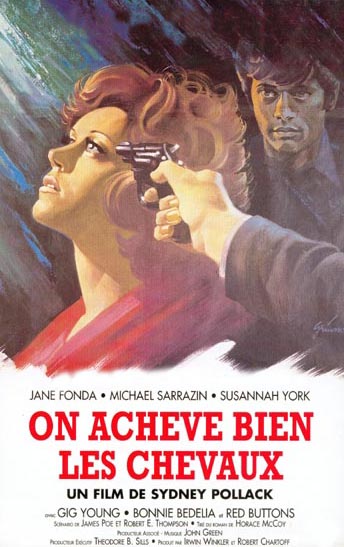
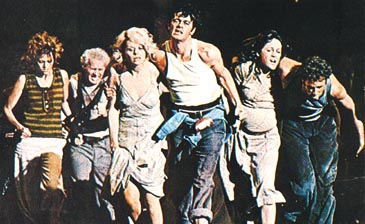
They Shoot Horses, Don't They? (1969)

Pamela's Nite
Nora's Birthday Dinner!
Dance Marathons via Wikipedia:

Marathon dancing fit in nicely with the 1920s craze for breaking records and stretching human endurance, with records being set in flagpole sitting, mountaineering, aviation, and more. Dance marathons started similarly, and ended up being one of the most widely attended and controversial forms of live theater.

Contestants and spectators alike bought into the staged excitement and competition. Spectators could cheer, make wagers and root for their favorite team, even interacting with the dancers, chatting with them and throwing money. Contestants were enticed by the potential for fame and fortune, from prizes of several thousand dollars to performing contracts, and were fueled by the audiences’ support and applause. Like professional wrestling, the contests were fixed, but both sides bought into the simulated reality of it and participated heartily, provoking each other and egging each other on. The newest episodic entertainment, spectators would return day after day to follow their heroes and see more drama unfold.

Many contestants, considering themselves theater professionals based on their marathon experience, traveled the country competing in one marathon after another. Especially during the Depression, marathons offered work, shelter, food, and potential for extra money and more. Contestants hoped to have careers in films, and though many took roles as extras, only the few who were veteran performers before entering, like June Havoc and Red Skelton, found real fame and entertainment careers after their marathon days.

Sunday, November 05, 2006

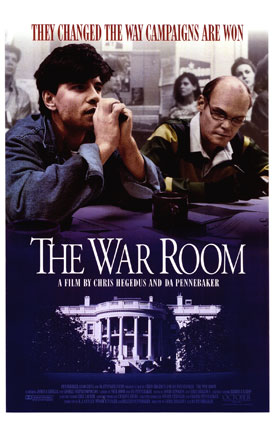
The War Room (1993)

Peter's Nite
Interview with DA Pennebaker and Chris Hegedus via BBC Four:

BBC Four: The film turned out quite differently from what you originally conceived didn't it?

Chris Hegedus: When we started The War Room, the idea was to watch a man become president. Our intention was to follow the candidates and go through this process with one of them. In the end we weren't granted the type of access necessary to make that sort of story, so we had to look around and ask, "Is there something else we can make here?" And the Clinton campaign was by far the most interesting one going, and then of course we stumbled upon James Carville.

BBC Four: Were you aware of Carville before?

CH: Not at all. He was someone we discovered in the process of making the movie. He was the Head of Strategy for the campaign and we thought, "My god, I can't believe this is the guy who's heading it, but if he is he'll certainly make a good character." And especially with George [Stephanopoulos] being a counterpart, a kind of buddy thing.

BBC Four: It is an odd film to watch with benefit of hindsight.

CH: It is strange, and parts of it are totally undone, like the beginning of the film with Jennifer Flowers. Clinton admitted to having an affair with her. These films that are about historical subjects change incredibly based on subsequent events.

DA Pennebaker: They are so focussed on the moment when they are done that they become like flies caught in amber. Not much that we have of history has that quality because it gets constantly sorted out by historians and people whose business it is to explain what or why it happened. This film doesn't explain anything, it just shows.

BBC Four: US elections get so much TV coverage. How did you think you were doing something different?

DAP: It's interesting. On the day of the election, suddenly ABC, who produced the Six O'Clock News, said they wanted to come into the War Room. And of course they were invited right in. We'd been there for months, and it felt that this was our little province, because no press was supposed to go into the War Room. But what they did was to centre the programme around Ted Koppel, the guy whose show it was. They could have made our film completely, but it didn't fit what they needed to do. It took too long to generate. It would've been a year before any of that stuff could be put out in way that people could go look at it.
BBC Four: Watching it now it seems so full of optimism for the Clinton administration.

DAP: You do see all those hopes and dreams. A year after we finished the film we showed it to everybody down in Washington. They came out of it really shellshocked because even after one year in the White House they were so burnt out. And watching their idealism in that film was very moving to a lot of the staff because it helped them to remember why they're there. It's a record of that spirit.

Sunday, October 22, 2006

A Tale of Two Cities (1935)

Nora's Nite
Beef, Grilled Veggies, Cookies, Ice Cream
Behind the scenes via TCM:
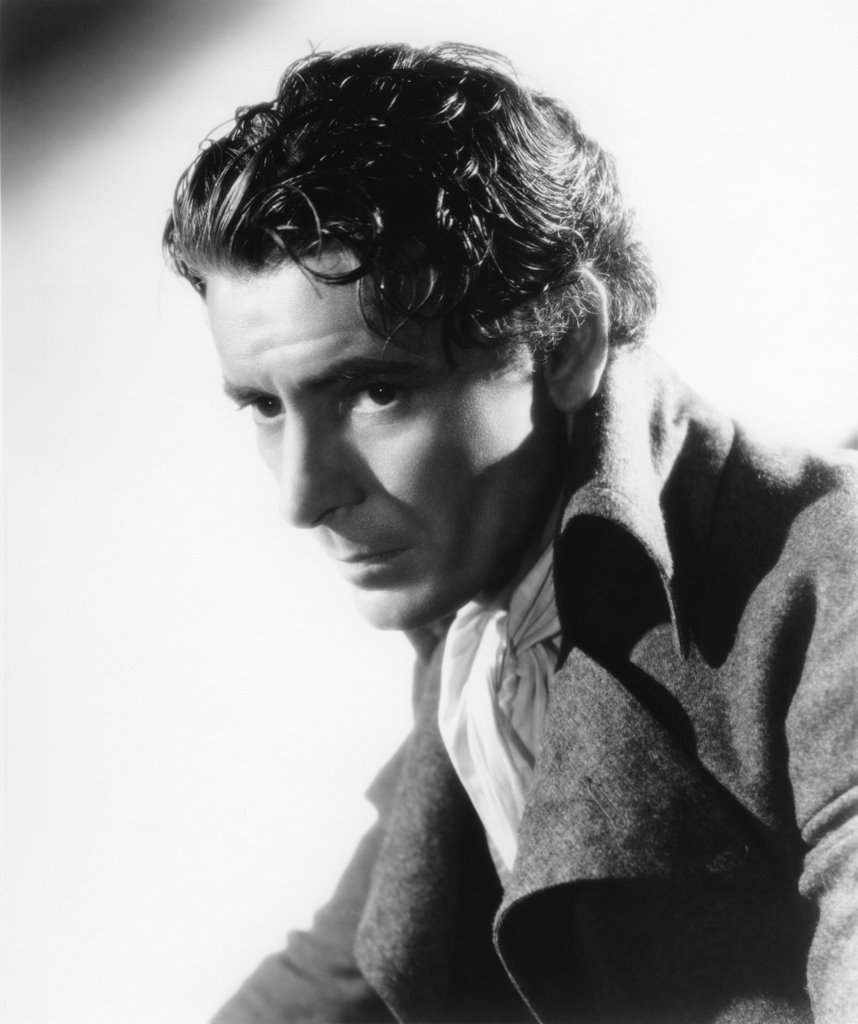
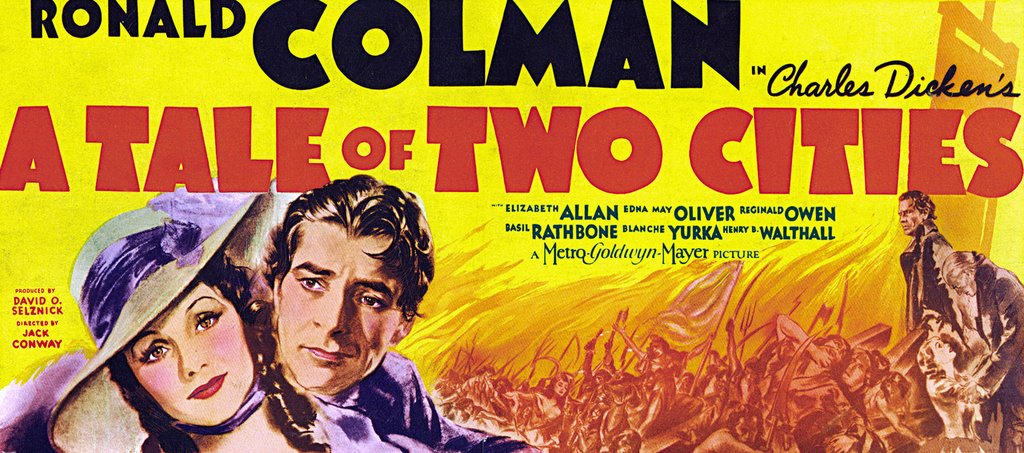
In 1934, David O. Selznick finally found himself in the position to build his own studio and become an independent producer. He declined renewal of his contract, against MGM's wishes, and accepted a $20,000 fee to finish producing Anna Karenina (1935) with Greta Garbo, and to oversee the shooting of another Dickens adaptation, A Tale of Two Cities (1935). Selznick had great success with David Copperfield in 1934 and retained many of the same cast members of that film, including Basil Rathbone, Elizabeth Allan and Edna May Oliver. Unlike David Copperfield (for which hundreds of boys auditioned for the title role), Selznick had no trouble finding a lead actor for A Tale of Two Cities. Ronald Colman had coveted the part since he began his career and knew the novel intimately. In an interview seven years before being cast as Sydney Carton, Colman reflected on Dickens' forte for characterization, stating that Carton "has lived for me since the first instant I discovered him in the pages of the novel." Reportedly, he became so engrossed in the process of making A Tale of Two Cities that he was present for all of the filming, whether or not he was on camera. Co-star Elizabeth Allan recalled the seriousness with which Colman approached the role: "He was very unjokey on the set, and we never had lunch together to go over lines or anything."
Selznick's legendary micromanagement, often a thorn in the side of those who worked with him, resulted in a stroke of luck for one actress. Isabel Jewell, who played the small but notable part of the seamstress who shares Sydney Carton's fate in prison, later recalled that Selznick personally lobbied for her to be cast in the part.
Up to that time, as Jewell later remembered, she had "played rip-roaring comedy stuff and Jack Conway (director of the film) would say to me, 'You're a marvelous little comedienne, but you can't play the part of a seamstress.' He refused to give me an audition." But Selznick prevailed and her audition was a success. Colman himself delivered the good news, dropping by her dressing room to tell her: "Isabel, I asked Mr. Selznick if I could come and tell you we have just seen your test of the seamstress and I am so happy that you are going to do the part." Jewell would go on to play opposite Colman again in Lost Horizon (1937) and also play Emmie Slattery in Selznick's greatest success, Gone With the Wind (1939).
Second-unit director Jacques Tourneur (Cat People, 1942; Out of the Past, 1947), responsible for shooting an exterior scene outside of the studio, held up shooting because of rain that persisted for five straight days. Selznick's memos -- signed DOS -- arrived daily to goad Tourneur into finishing shooting no matter what the weather. A frustrated Tourneur turned the tables on his boss, firing off a memo stating that he could not control the delay due to "an act of GOD," signing off in an imitation of the producer's familiar style.
Selznick's obsessive habit of voicing his wishes through voluminous memos later garnered the wrath of MGM's publicity department. After the film was wrapped, the concerned producer sent missives pleading that although he was departing MGM and "[would] not be here to fight the battles of A Tale of Two Cities [make] sure that it is handled properly by the sales and advertising departments.... I hate to make my valedictory to the company a letter of bitter complaint." Miffed at finding the note carbon copied to executive staff at the studio, Howard Dietz, of the PR department, fired back, "I have tried to figure out why you've been so ignored and decided that it was that shy, shrinking personality of yours...." Angry memos were again exchanged, and finally, Selznick, on the advice of his wife (literally, the boss' daughter, Irene Mayer), offered conciliatory best wishes for the film and departed for his own offices at the newly created Selznick International Pictures.

Sometimes Selznick's attention to detail could be maddening, but because his concentration was divided between the production and setting up his own company, A Tale of Two Cities contains a few questionable details. For example, in the scene of the storming of the Bastille, male stuntmen dressed as women noticeably betray their true gender; when Madame Defarge and Miss Pross fight each other in a climatic scene, their stuntmen doubles are painfully obvious. But, according to Selznick, the audience at the Long Beach sneak preview, mostly composed of rowdy sailors and their dates, loved every minute of it.

For more on Selznick see our Portrait of Jennie entry.

Sunday, October 08, 2006

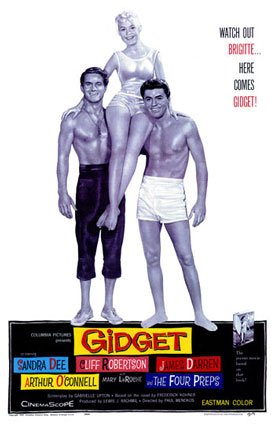
Gidget (1959)


Pamela's Nite
Meatloaf, mashed potatoes, broccolini and blueberry pie and ice cream.
TCM on Gidget:

1959 was a big year for Sandra Dee, the perky ingenue born Alexandra Zuck. In addition to Gidget, she also appeared in two other big films that year - as Lana Turner's daughter in the Douglas Sirk melodrama Imitation of Life, and as Molly, the female lead opposite Troy Donahue in the sexually charged A Summer Place. The success of these movies solidified Dee's status as one of the screen's most promising young actresses.

James Darren (Moondoggie) had been a student of respected acting coach Stella Adler. Like Dee, he too was considered a rising young talent at the time of Gidget's release. Also a singer, Darren lent his vocal talents to Gidget, crooning the theme song and "The Next Best Thing to Love." He went on to record such top-40 hits as "Goodbye Cruel World" and "Her Royal Majesty" later in his career.

Gidget was based on the popular novel of the same name by Frederick Kohner, who based the title character on the adventures of his own daughter, Kathy. The book was adapted for the screen by Gabrielle Upton. But no one could have guessed what a phenomenon Gidget would become. It spawned two film sequels (Gidget Goes to Rome (1963) and Gidget Goes Hawaiian, 1961), two television series (Gidget (1965-66) and The New Gidget, 1986), and several TV movies along the way. Sandra Dee did not reprise her role in any of the sequels, though co-star James Darren portrayed Moondoggie twice more in Gidget Goes to Rome and Gidget Goes Hawaiian.
The real "Gidget" via The Honolulu Star-Bulletin:

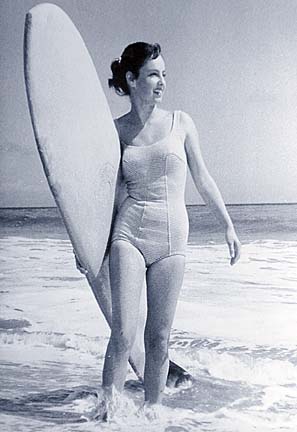
It was sun-kissed, private, in the country, glassy perfect waves rolling in from across the wide Pacific, a hideaway for kids fascinated by the tiny subculture of surfing. They all had nicknames: Tubesteak, Quik, Golden Boy, Scooterboy, The Jaw, The Fencer, Kahuna, Moondoggie.

Kohner, tiny and determined, bought a surfboard for $35 and insisted on being included. The kids at the beach dubbed her "Gidget," for "girl midget."

That was the past. Let's go to the present. Gidget, now Kathy Kohner Zuckerman -- and marking her 36th wedding anniversary with husband Marvin Zuckerman -- turned 60 this weekend. But what else can we call her, other than Gidget? The term "Gidget" is not only part of the English language, it is is a vital link to one of the major American cultural shifts of the 20th century, the celebration of the beach and of youth culture. Gidget is an icon to teen-age girls everywhere, and a kind of team mascot in surfing history.

Gidget's father, screenwriter Fred Kohner, wrote a 1958 novel based on his daughter's experiences and within six weeks of publication, a film based on the book was in preparation. Starring Sandra Dee, Cliff Robertson and James Darren, "Gidget" was an enormous hit in 1959, the first Hollywood motion picture to feature surfing, spawning sequels, more novels and a couple of TV series.

Sunday, October 01, 2006

Sunday, September 10, 2006

Insomnia (1997)


Stuart's Nite
French Pizza, Salad, Ice Cream
Special guest: Lisa
Phrase for the night: Den som synder, sover ikke.
Nikolaj Frobenius Fra Wikipedia, den frie encyklopedi

Nikolaj Frobenius, født i 1965, norsk forfatter som debuterte i 1986 med prosatekstsamlingen Virvl. Utdannet ved London Institute of Screenwriting, har skrevet flere filmmanus og arbeider fra 2005 som filmkonsulent for Norsk filmfond.

Frobenius har tidligere vært redaktør for litteraturtidsskriftet Vinduet. Hans roman Latours katalog er oversatt til en rekke språk.

Frobenius utga i 2004 romanen Teori og praksis, som han kalte en "løgnaktig selvbiografi" om oppvekst på Rykkinn.
Stellan Skarsgard interview via Reel.com:
Q: OK, let's talk about Insomnia. Did you do any research for the role of Inspector Engstrom? Did you see any cop films or go on any police ride-alongs?

SS: No, nothing.

Q: Really? [Notes shuffle frantically.] Well then, did the film have any basis in reality? Have there ever been any serial killer cases in Scandinavia?

SS: Not that I can think of. But I think this sort of crime could happen anywhere in the world. Now, when I say I didn't do any research, I mean I didn't do too much real-world research. The problem in making a character like [Engstrom] is not trying to behave in a police-like manner, but rather to get under his skin and figure out what's happening to him mentally, to show his internal conflict. I'm not so much worried about the physical specifics. I think the real key to making any character believable are the human specifics of his profession and his personality.

Q: What do you think sets Insomnia apart from Hollywood serial killer thrillers like The Silence of the Lambs or Seven?

SS: What sets Insomnia apart is the way [director] Erik Skjoldbjaerg made the movie. The entire picture was closed in, it was isolated from the surrounding area, even the way he shot -- the whole thing was claustrophobic. Also, while the film does have a thriller story with a fast pace, etc., that's not what he concentrated on. He focused more on the breakdown of this guy [Engstrom], who was a supercop, but had gradually been destroyed by his work, and this incident [the murder] especially. He also had a reputation he wanted to uphold. He didn't want to take this particular investigation, but he couldn't afford to lose it if wanted to stay a well-respected professional.


Q: Do you think this kind of inner conflict is missing from a lot of films today?

SS: Yeah, it is, but I always try to find inner conflict in every role I play. I try to find contradictions even incharacters which, in the script, are very weak, very one-dimensional, because it's no fun to just say the f**king words and get out of there. My view of mankind is that everybody, within them, has many contradictions, many conflicts. If I play a bad guy, I try and find some good in him, or at least something that makes him more interesting, more alive than bad. As for good guys, well, they're often good for reasons that are very selfish. I did a lover once in a Moliére play. But rather than just have him be "in love," I made it so he was in love with himself, and in love with himself being in love, but not in love with the woman he was seeing.

Peter Cowie via Criterion:

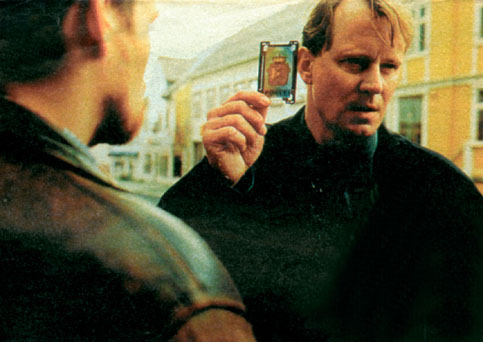
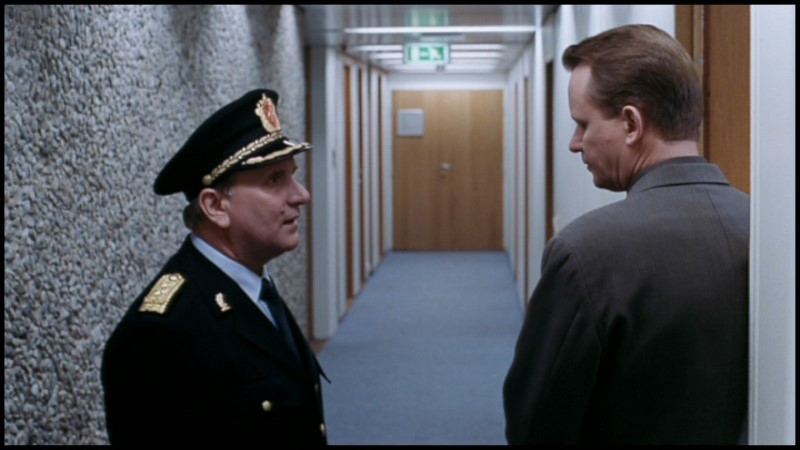
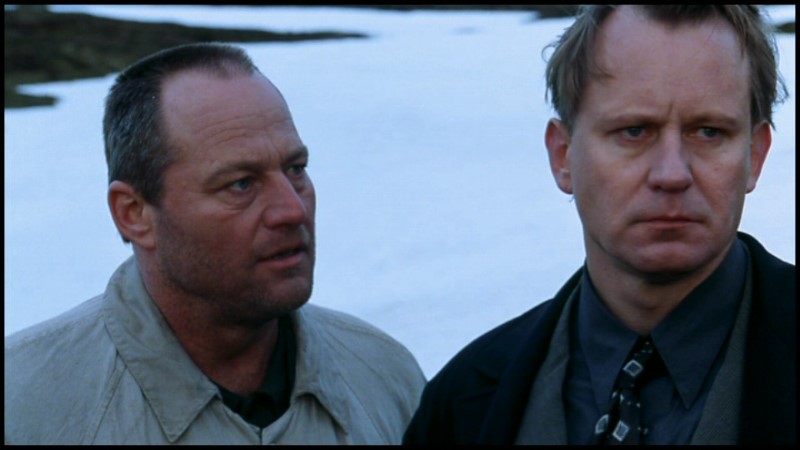
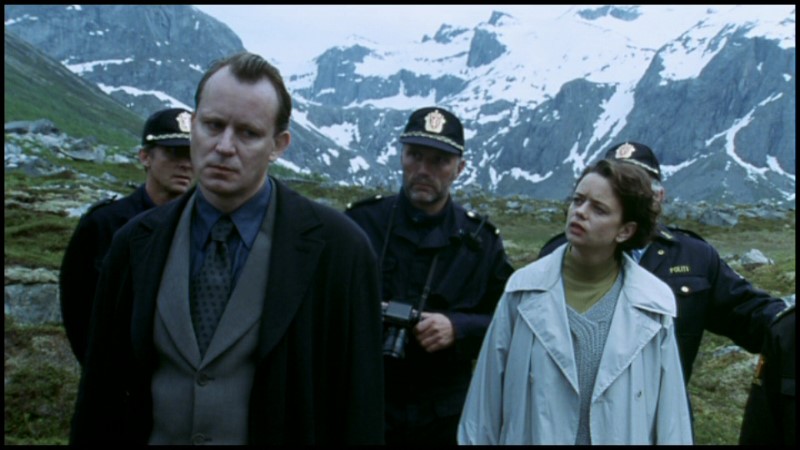
As a detective who travels to the coastal town of Tromsø to help solve a local murder, Skarsgård’s Jonas Engström finds himself taunted by locals and climate alike. He cannot sleep as the glaucous light of the midnight sun glares through his hotel window, and he loses himself---–and his reason—in the fog-shrouded landscape. This all-pervasive mist forms when the ocean is warmer than the air above it. In the film it creates a mood of claustrophobia as well as ambiguity. Did Engström kill his partner, Vik, during a chase in some rocky wasteland? Is he really interested in the attractive receptionist at the hotel? Does he have a nasty skeleton in the closet of his past?

Skjoldbjærg had been introduced to Skarsgård through Hans Petter Moland, who had made Zero Kelvin with the Swedish star. “The moment he walked through the door in Stockholm, I knew I had found the right actor,” says Skjoldbjærg. Like Jean-Louis Trintignant in Bertolucci’s The Conformist or Marcello Mastroianni in Visconti’s adaptation of Camus’ The Stranger, Skarsgård creates a man who is outwardly assured while harboring profound insecurities within. He cannot handle any kind of intimacy, nor can he come to terms with his responsibility for the death of Vik. He sustains his identity by adhering to certain moral precepts; once he has broken one of these principles, he becomes truly dangerous...

Cannes 1997 via filmfestivals.com:

Unlike many directors," says 32-year-old Norwegian director Erik Skjoldbjaerg, whose feature debut Insomnia is screening today as Norway's second ent in this year's Critics' Week, "I do not claim that I know my characters in every way. I strive hard to understand them, but some of their actions still defy a clear explanation. Actually, I am very thankful for that."

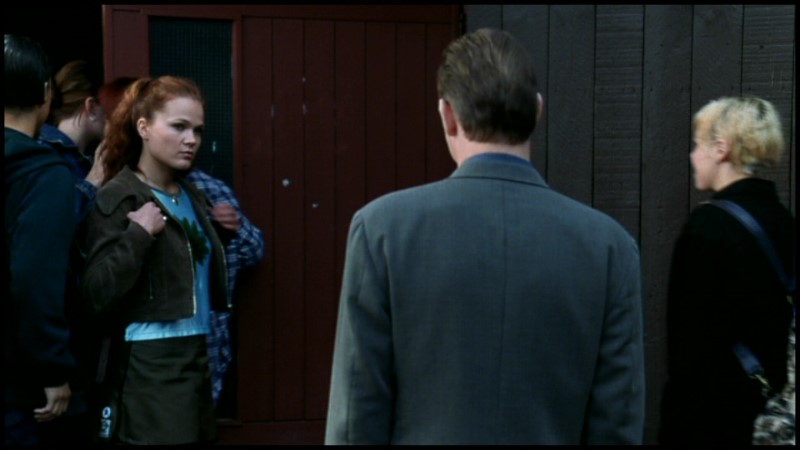
A psychological thriller shot in northern Norway ("but with no glamorous pictures of beautiful nature"), Insomnia follows the investigation of a murder. The corpse of a 17-year-old girl has been found, wrapped in plastic. The local police call for assistance from Kripos, the national detective squad and two experienced criminal investigators are sent to solve the mystery.

A second killing sets the police detectives - played by Swedish actor Stellan Skarsgard (Breaking the Waves) and Sverre Anker Ousdal - off on an intense race, pushing Jonas Engstroem (Skarsgard) towards a mental breakdown. From the lack of sleep, when unsuccessfully trying to shut out the northern light from his hotel room, he enters a state of hallucinations.


"We were struck by the idea of making 'a reversed film noir with light, not darkness, as the dramatic force. And we began guiding our main character through sleepless nights until he gradually lost touch with himself and his ideals," explains Skjoldbjaerg.

From an original screenplay by first-time feature film witer Nikolaj Frobenius, Insomnia was inspired by secrecy. "When you try to hide something from others, you risk losing your own perspective. The secret may involuntarily begin to occupy an increasing part of your own attention. We took this idea to the extreme." Jrn Rossing Jensen.
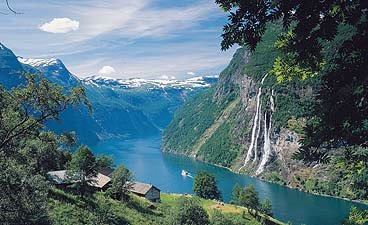
Why Norway? via VisitNorway.com:

Why Norway?


Imagine a country where nature is a majestic gift to mankind. Imagine a country enjoying the abundance of nature. Accumulated through thousands of years. You will discover a country, which is enchantingly unique. Natural. Imagine a country where light and darkness intertwine. Where seasons melt together in colours and crystals. Imagine a country where the thawing snow gives way to blossom. Where sea and mountain unite. Discover a country where nature creates art. Where you are invited to a life-fulfilling experience of diversity.

Friendly, down-to-earth people, unique scenery, summer nights bright as day and delightful snowy winters make Norway a very special country. In summer, there are plenty of attractions and activities to keep you busy - the unspoilt open country of the Sámi people in the north and fjords, salmon fishing and festivals in the south.